How Microplastics Regulate Soil Carbon Storage via Mycorrhizal Fungi and Glomalin
Microplastics, defined as plastic particles ≤ 5 mm in size, have emerged as a global environmental concern due to their widespread distribution and potential toxicity to ecosystems and human health. While research on microplastics has traditionally focused on marine environments, increasing evidence suggests that terrestrial ecosystems, particularly island soils, may act as important but underrecognized reservoirs for microplastic pollution.
Based on This previous investigations on the distribution characteristics of microplastics in the soil under different types of vegetation in the Xisha Islands, This observed a significant amount of microplastics in the soils of shrub and tree communities, which is closely related to marine floating debris and human activities, highlighting the vulnerability of coral island ecosystems to plastic pollution.
As carbon-based materials, microplastics and their degradation products have the potential to directly interfere with soil carbon cycling. Soil microorganisms and their byproducts play a central role in regulating soil organic carbon (SOC) storage. However, the mechanisms by which microplastics influence microbial-derived soil carbon processes have remained largely unclear. To address this knowledge gap, This conducted a controlled pot experiments in greenhouse, by planting Scaevola taccada, (the most dominant shrub species on coral islands of the South China Sea) in the coral sand with different amount of conventional and biodegradable microplastics, respectively. This aimed to evaluate the effects of conventional and biodegradable microplastics on soil microbial necromass carbon (MNC), glomalin-related soil protein (GRSP), and the community structure of arbuscular mycorrhizal fungi (AMF) and bacterial.
The results revealed that microplastics significantly enhanced SOC accumulation, with biodegradable microplastics exerting a more pronounced effect than conventional plastics. Microplastic exposure reshaped bacterial and AMF community structures, strengthened symbiotic network stability, and highlighted the pivotal roles of key taxa such as Proteobacteria, Glomus, and Paraglomus in regulating MNC and GRSP dynamics. Notably, GRSP emerged as a dominant mediator of SOC stabilization under microplastic stress. These findings provide mechanistic evidence showing how microplastic pollution reshapes belowground carbon processes and offer important scientific insights for improving global change models and optimizing soil management strategies.
This also found that biodegradable microplastics inhibited the growth of Scaevola taccada. This result underscores the need for caution when promoting biodegradable plastics as alternatives to conventional plastics, particularly in sensitive island ecosystems. Comprehensive assessments of their potential impacts on plant growth and ecosystem functioning are essential before large-scale adoption.
The research findings were recently published in the Journal of Hazardous Materials with a title “Arbuscular mycorrhizal fungi and glomalin mediate the effects of microplastics on soil carbon storage”. The study was led by doctoral candidate NING Kai as first author, with Professor JIAN Shuguang serving as corresponding author, both from the South China National Botanical Garden, Chinese Academy of Sciences. This work was supported by the National Key Research and Development Program of China and related funding sources. Article link: https://doi.org/10.1016/j.jhazmat.2025.140426
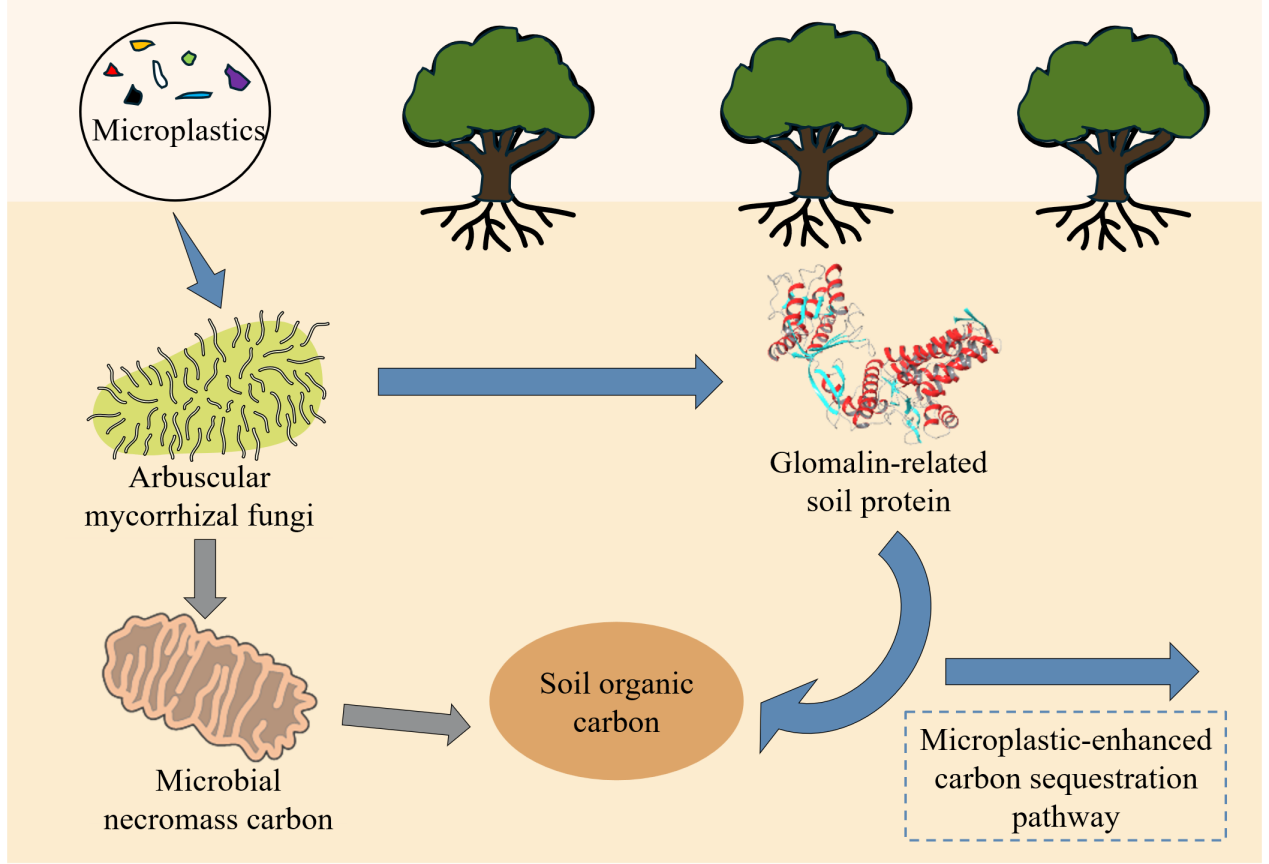
(Image by JIAN et al.)
File Download: