Global Change Ecology Research Team Reveals the Source-Sink Dynamics of Microplastics in Mangroves and Their Driving Mechanisms
Recently, the Global Change Ecology Research Team from the South China Botanical Garden, Chinese Academy of Sciences, published their latest research findings on Journal of Hazardous Materials, offering a new perspective on the source-sink dynamics of microplastics (MPs) in mangrove ecosystems. Combining field investigations and indoor resuspension simulation experiments, the study revealed that mangrove plants can promote MPs deposition through physical interception. However, intense hydrological disturbances caused by extreme weather (e.g., typhoons) can induce the resuspension of sedimentary MPs (with a critical shear stress of approximately 0.024 N/m²), transforming mangroves into a “secondary” source of MPs. This research provides quantitative evidence for the “source-sink” dynamics of MPs in mangroves and is expected to deepen the comprehensive understanding of the environmental behavior of MPs in intertidal ecosystems.
1. The proposal of scientific questions
MPs in the environment (with a diameter less than 5 mm) mainly originate from the fragmentation and decomposition of polymer plastic products. As a new type of pollutant, they have attracted global attention due to their threats to human health and ecosystem security. Driven by industrial, agricultural, and daily needs, the global production of plastic products has surged from 2 million tons in 1950 to 460 million tons in 2019. However, inadequate recycling and disposal of waste plastic products have led to a large amount of plastics (including MPs) entering rivers and ultimately flowing into the ocean. Estuarine and coastal zones effectively impede the migration of MPs, resulting in an imbalance between the input flux of MPs into rivers and the output flux from rivers to the ocean.
In intertidal zones, mangrove ecosystems, characterized by high biomass, can effectively reduce tidal current velocity, facilitating MPs deposition and thus serving as important "sinks" for MPs. Nevertheless, intense hydrological disturbances caused by extreme meteorological events (such as typhoons and storm surges) may trigger the resuspension of sedimentary MPs into the water column, converting mangroves into "source". Existing studies have mostly focused on the horizontal distribution characteristics of MPs in mangrove sediments, while key information such as vertical distribution patterns, interception efficiency, and hydrodynamic critical conditions for MPs resuspension with its selective characteristics remains insufficiently understood. The mechanism underlying the “source-sink” conversion of MPs remains unclear.
Against this backdrop, this study aims to address the following scientific questions: (1) What role do mangrove plants play in intercepting floating MPs, and are there differences among different plant species? (2) What critical conditions are required for the resuspension of MPs in mangrove sediments, and is there selectivity for MPs with different characteristics (shape, size, and density)?
2. Equipment of resuspension experiment
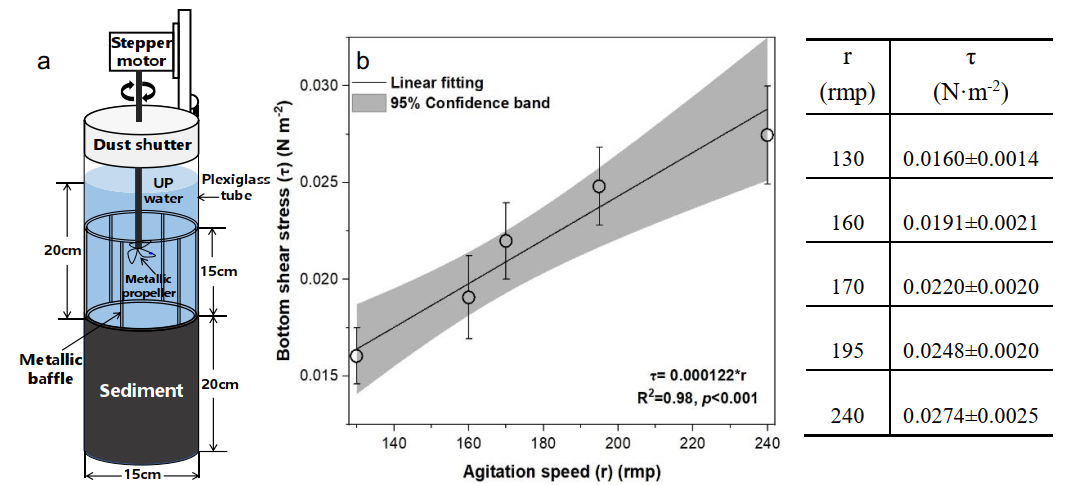
The resuspension simulation experiment in this study was conducted using a modified EROMES erosion system, consisting of an erosion tube with an inner diameter of 15 cm, a turbulence baffle, and a stirrer. A rotating propeller was installed 7.5 cm above the sediment-water interface, and the built-in turbulence baffle was used to reduce swirling flow, ensuring that the sediment was subjected to uniform shear stress for resuspension. The threshold rotation speed for quartz sand resuspension was determined based on the surge point of turbidity, and the critical shear stress was calculated using empirical formulas to calibrate the response relationship between bottom shear stress and rotation speed. This study employed the EROMES system to quantitatively analyze the critical shear stress for the resuspension of sedimentary MPs, marking the first application of this device in MPs dynamics research.
(Image by GAO et al.)
3. Key Research Results
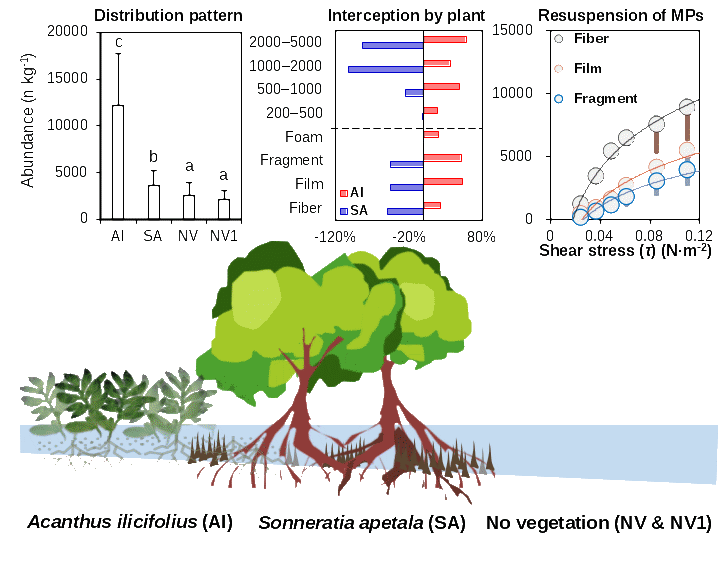
(1) MPs Distribution Characteristics: The abundance of MPs in sediments significantly increased from the non-vegetated (NV) mudflat to mangroves, with the highest enrichment index (5.24 ± 2.55) observed in the Acanthus ilicifolius (AI) transect. Similarly, the abundance of MPs in surface water showed a landward increasing trend, and significantly higher MPs abundance (1.84~2.82 times higher) was observed under extreme hydrodynamic conditions induced by Typhoon Yagi.
(2) MPs Composition Characteristics: Fibers were the dominant shape of MPs in both sediments and surface water, followed by films and fragments, with foams being the least common. Transparent MPs occurred more frequently than those of other colors. MPs in the size range of 500~1000 μm accounted for the highest proportion. The polymer types were mainly low-density polyethylene (PE), polypropylene (PP), and PE-PP blends. However, a higher proportion of PMMA (polymethyl methacrylate) MPs (5 times increase) was observed under extreme hydrodynamic conditions. In addition, the diversity index of MPs in mangrove transects was higher than that in the non-vegetated mudflat.
(3) Interception of MPs by Mangrove Plants: Under normal hydrodynamic conditions, the interception rate of floating MPs by Acanthus ilicifolius reached 40 ± 8%, while Sonneratia apetala (SA) failed to effectively intercept MPs (−56 ± 44%). Under extreme hydrodynamic conditions, neither Sonneratia apetala nor Acanthus ilicifolius exhibited interception effects on MPs (SA: −179 ± 147%; AI: −44 ± 14%), indicating that mangrove sediments become an important source of floating MPs in the water column.
(4) Resuspension Dynamics of MPs: Compared with the non-vegetated mudflat (bottom critical shear stress: 0.021 N/m²), mangrove sediments showed stronger resistance to MPs resuspension (AI: 0.024 N/m²; SA: 0.023 N/m²). Furthermore, MPs resuspension was influenced by their physicochemical properties, with medium size, fibrous shape, and low density being highly sensitive traits for MPs resuspension.
4. Research Conclusions
Based on the evidence chain collected from field observations and indoor experiments, the core conclusions of this study are as follows: Mangroves act as long-term "sinks" for MPs through plant interception and radiation shielding effects, significantly enriching MPs and altering their composition characteristics (e.g., color). However, extreme hydrodynamic conditions induced by typhoons can drive the resuspension of sediment-bound MPs, transforming mangroves into non-negligible "secondary" sources of MPs. The research results provide quantitative evidence for the environmental behavior of MPs in intertidal ecosystems, confirm the potential of fibrous MPs as indicators of resuspension responses, and offer a scientific basis for assessing MPs pollution risks under extreme hydrological conditions.
(Image by GAO et al.)
The related findings were published in the CAS Tier 1 TOP journal Journal of Hazardous Materials (IF = 12.4) with the title “New Insights into Sink-Source Dynamics of Mangrove for Microplastics: Quantitative Evidences from Field Observation and Resuspension Simulation”. Post doctor LI Rui and Associate Professor GAO Lei from the South China Botanical Garden, Chinese Academy of Sciences the first author and the corresponding author of this paper, respectively. This study was supported by the National Natural Science Foundation of China and the Natural Science Foundation of Guangdong Province. Article link: https://doi.org/10.1016/j.jhazmat.2025.140590
File Download: