Elevation Aggravates Phosphorus Limitation of Soil Microorganisms in Tropical Forests
Researchers from the Ecology and Environmental Science Center of the South China Botanical Garden, Chinese Academy of Sciences, in collaboration with international partners, have demonstrated that soil microorganisms in tropical forests are widely constrained by phosphorus (P) availability, and that this limitation becomes significantly stronger with increasing elevation. The findings were recently published in Soil Ecology Letters.
The research was conducted along three representative tropical forest elevational gradients in Guangdong and Hainan Provinces, covering elevations from approximately 100 to 1,400 m. By integrating measurements of soil extracellular enzyme activities with eco-stoichiometric analyses, the team quantitatively assessed microbial metabolic limitations of carbon (C), nitrogen (N), and phosphorus across contrasting climatic and vegetation conditions.
Results showed that microbial metabolism was consistently characterized by strong phosphorus limitation across all sites, with the severity of P limitation increasing markedly at higher elevations where temperatures are lower. In contrast, microbial carbon limitation was generally weak and exhibited no uniform elevational pattern.
Further analyses identified temperature as the dominant environmental factor regulating microbial nutrient limitation. Declining temperatures at higher elevations reduced phosphorus release through organic matter mineralization and mineral weathering, while simultaneously stimulating microbial investment in phosphorus-acquiring enzymes. These patterns indicate a trade-off in microbial resource allocation between carbon and phosphorus acquisition.
Elevation gradients serve as an effective spatial analogue for assessing climate change impacts. The findings suggest that future warming may partially alleviate phosphorus limitation in tropical forest soils, but could also increase microbial carbon limitation, with potential consequences for soil organic carbon turnover and long-term carbon stability.
This study enhances understanding of belowground microbial processes in tropical forests and their sensitivity to climate change, providing important implications for terrestrial carbon-cycle modeling and tropical forest management under global change.
The study was led by Dr. KUANG Luhui (former postdoctoral researcher) as first author, with Prof. LIU Zhanfeng as corresponding author, and was supported by the National Natural Science Foundation of China. Paper link: https://doi.org/10.1007/s42832-026-0403-x
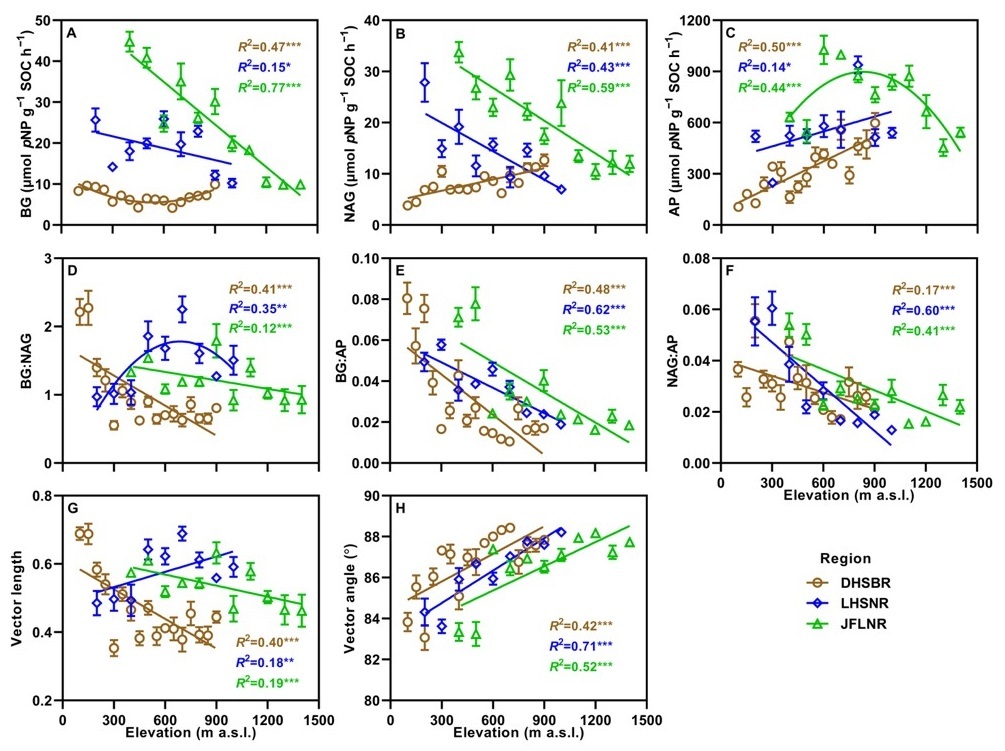
Fig. Extracellular soil enzyme activities (A-C) and their stoichiometry (D-F) and microbial nutrient limitations (G-H) along elevation gradients in DHSBR, LHSNR and JFLNR. Values are means ± standard errors (n=5). ns, not significant; *, p < 0.05; **, p < 0.01; ***, p < 0.001. BG, β-1,4-glucosidase; NAG, β-N-acetyl glucosaminidase; AP, Acid phosphatase; vector length represents microbial C limitation; vector angle represents microbial N or P.(Image by LIU et al.)
File Download: