Coniferous Litter Promotes Soil Carbon Stabilization in Subtropical Forests
Researchers from the South China Botanical Garden of the Chinese Academy of Sciences have uncovered a new mechanism by which tree litter regulates soil carbon stabilization in subtropical forests. Their study shows that, contrary to the conventional view that high-quality litter contributes more effectively to soil carbon accumulation, coniferous litter—with lower nutrient quality and slower decomposition—can promote soil organic carbon sequestration more efficiently than broadleaf litter. The findings provide new insights into forest soil carbon cycling and offer scientific support for improving carbon sink capacity through forest restoration and tree-species selection.
Plant litter is a major source of soil organic carbon in forest ecosystems, yet the role of litter quality in carbon formation and stabilization has remained controversial. To address this issue, the restoration ecology team at the Guangdong Heshan National Observation and Research Station for Forest Ecosystem conducted a 360-day incubation experiment using litter from twelve representative subtropical tree species, including deciduous broadleaf, evergreen broadleaf, and evergreen coniferous species. By combining the experiment with natural carbon isotope tracing (δ¹³C), the researchers tracked the transformation of litter-derived carbon in soil and quantified its allocation to key soil carbon fractions, especially mineral-associated organic carbon (MAOC) and particulate organic carbon (POC).
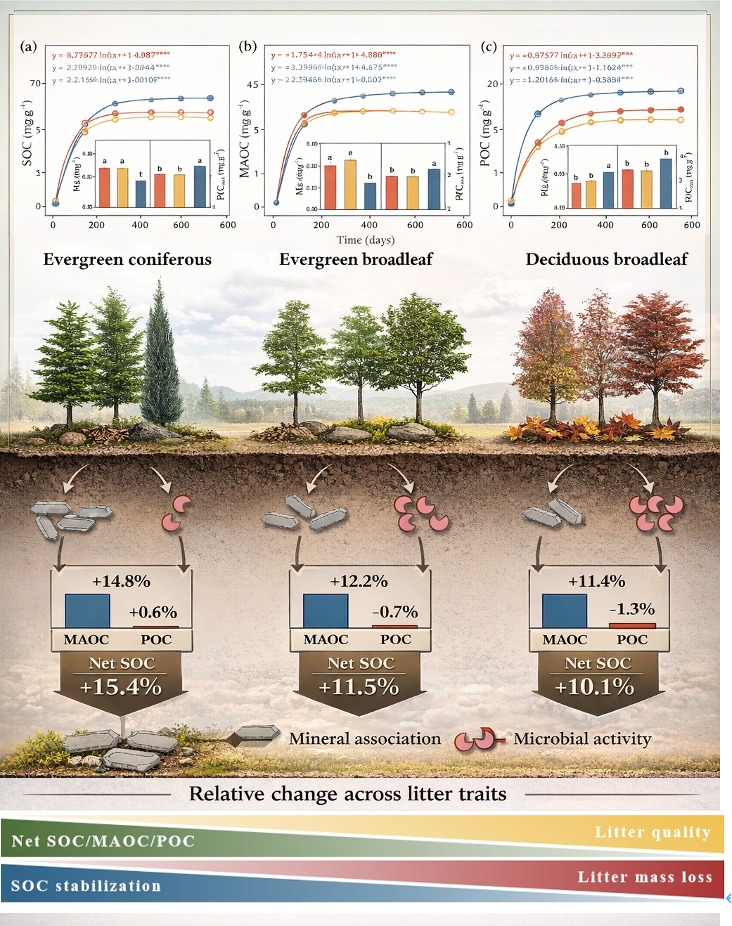
Figure. Conceptual diagram illustrating how litter decomposition from different plant growth forms drives the formation and stabilization of soil organic carbon.(Image by LIU et al.)
The results showed that coniferous litter decomposed 18–32% more slowly than broadleaf litter but contributed 1.4–2.1 times more to net soil organic carbon accumulation. Its carbon conversion efficiency reached 28–32%, significantly higher than the 11–19% observed for broadleaf litter. Further analysis revealed that coniferous litter significantly enhanced the formation of MAOC, which accounted for more than half of the net increase in soil organic carbon, highlighting the critical role of mineral protection in long-term carbon stabilization. Mechanistically, the higher carbon-to-nitrogen ratio of coniferous litter intensified microbial nitrogen limitation, thereby reducing microbial decomposition intensity and allowing more carbon to remain in soil. In addition, dissolved organic carbon released during coniferous litter decomposition was more likely to bind to mineral surfaces, further promoting the formation of stable carbon pools.
The study challenges the traditional assumption that high-quality litter is always more favorable for soil carbon storage and instead suggests that low-quality coniferous litter can enhance carbon persistence through slower decomposition and stronger mineral association. These findings have important implications for subtropical forest restoration and afforestation practices, indicating that the strategic inclusion of tree species producing more recalcitrant litter may help improve long-term soil carbon sequestration. The study was recently published online in the Journal of Plant Ecology. Dr. WU Panpan of the South China Botanical Garden is the first author, and Prof. LIU Zhanfeng and Prof. MAO Rong are the corresponding authors. The research was supported by the National Natural Science Foundation of China. Article link: https://doi.org/10.1093/jpe/rtag040
File Download: