Decode Cold Tolerance Difference Mechanism in Banana - Fruit from A Large Herbal Plant
Chinese researchers have uncovered the molecular mechanism underlying the cold tolerance difference in banana, fruit from a large herbal plant that could play a role in global food security.
The study, conducted by researchers at the South China Botanical Garden under the Chinese Academy of Sciences and collaborators, was recently published in Journal of Advanced Research.
As typical tropical and subtropical crop, banana is very sensitive to low temperature and is prone to chilling injury, resulting in huge economic losses. On the other hand, the cold tolerance of banana with different genotypes varies significantly. A class of Cu-miRNA that is upregulated under copper deficiency mostly targets genes encoding copper-containing proteins. The team's previous research found that miR528 (one of the Cu-miRNAs) plays an important regulatory role in the chilling injury of cold-sensitive banana with AAA triploid genotype, but whether there is a connection between the formation of different genotypes of banana cold tolerance and Cu-miRNA regulation, as well as the specific regulatory mechanism, are still unclear.
This study explored the molecular mechanism by which Cu-miRNA regulates the difference in cold tolerance between AAA type (Cavendish) and ABB type (Pisang Awak) banana fruits. The researchers revealed that there is a significant correlation between fruit antioxidant capacity and Cu-miRNA accumulation, and Cu-miRNAs participate in the regulation of redox homeostasis by targeting multiple copper-containing redox enzymes. Further research revealed that the expression levels of upstream transcription factors MaSPL4/5 and their transcriptional regulatory intensities on Cu-MIRNA genes vary, which may be the key factors leading to the differential accumulation of Cu-miRNA in the two types of banana fruits, i.e., higher Cu-miRNA accumulation in cold-tolerant ABB type banana, which is related to higher expression levels of MaSPL4/5 and stronger activation of MaSPL4/5 on Cu-MIRNA promoter of the B genome. Subsequently, transient overexpression of miR528 (OE-miR528) in cold-tolerant AAA type banana peel could alleviate chilling injury, while transient silencing of miR528 (STTM-miR528) in the cold-tolerant ABB type banana peel could aggravate chilling injury.
Based on these findings, a hypothetical mechanism of Cu-miRNA-mediated difference in cold tolerance between AAA and ABB varieties of banana fruits was proposed. “This study expands the understanding of the molecular mechanism of banana cold tolerance difference and provides potential target molecules for breeding new varieties adapted to low-temperature environments,” said Dr. KONG Xiangjin, one first author of this study. Article link: https://doi.org/10.1016/j.jare.2025.06.084
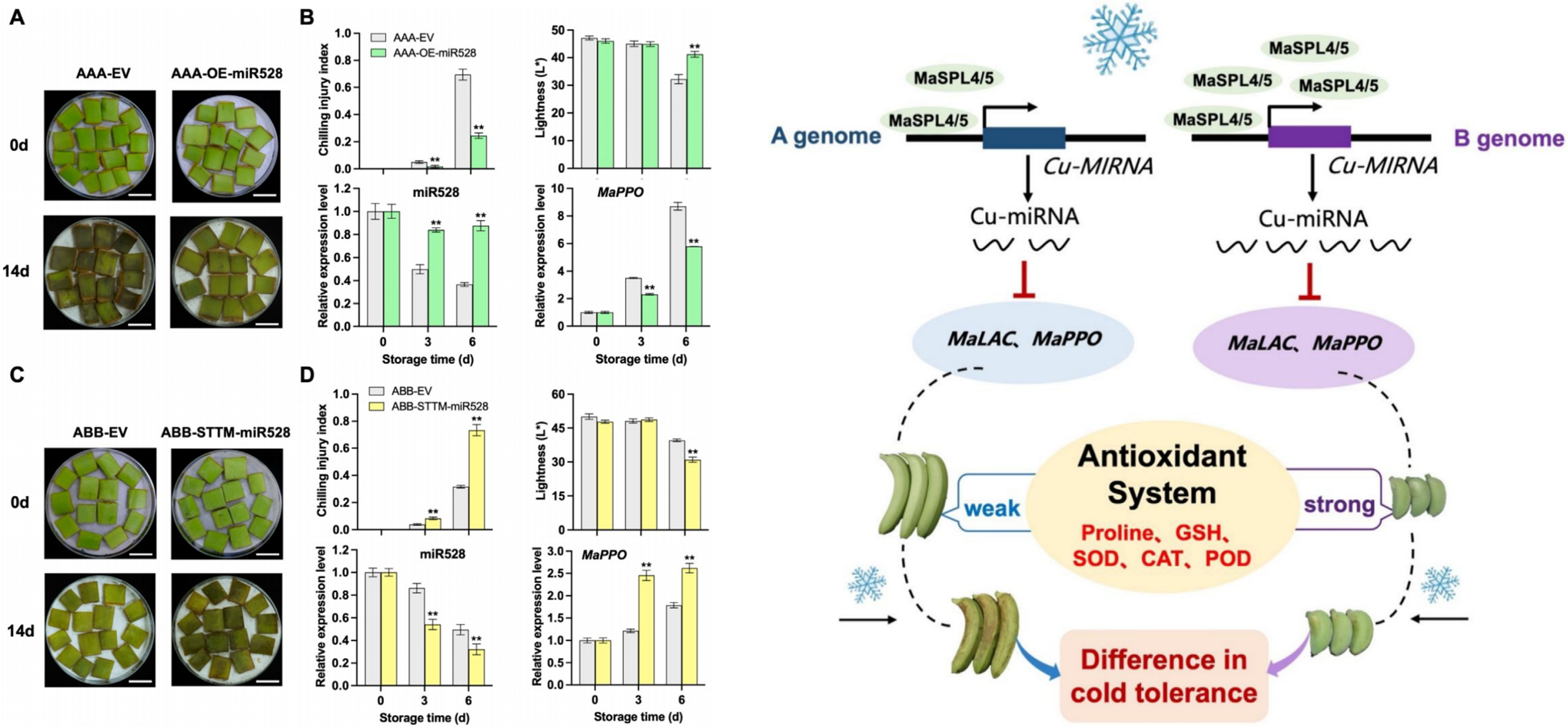
Fig. The left figure shows the effects of miR528 (representative Cu-miRNA) on the peel chilling injury and gene expression of the two banana varieties (AAA and ABB genotypes). The right figure demonstrates the hypothetical mechanism by which Cu-miRNAs mediate the difference in cold tolerance between AAA and ABB varieties in banana.(Image by ZHU et al.)
File Download: