Long-term N and P addition reshapes multi-element allocation patterns and network interaction in South China plantation trees
Nitrogen (N) deposition disrupts mineral element dynamics, exacerbating phosphorus (P) limitation and inducing multiple nutrient imbalances. Although P addition is widely adopted to mitigate these negative effects by enhancing P availability, how multi-mineral elements in tropical trees respond to N and/or P addition remains poorly understood, particularly regarding their tissue-specific concentrations and inter-element relationships.
Here, two typical plantation tree species, Eucalyptus urophylla (EU) and Acacia auriculiformis (AA), in southern China, were selected. Using a long-term N and P addition experimental platform in Heshan, Guangdong Province, this investigated the effects of a decade of N and/or P addition on mineral element concentrations across tissues in both tree species, and also examined how these additions altered correlations among elements.
The results showed that both EU and AA maintained stable macro-element (N, P, S, K, Na, Ca, and Mg) levels under long-term N addition, yet experienced significant changes in their micro-elements (Al, Fe, and Mn), particularly for root Al and Fe in EU and leaf Fe in AA. Long-term P and N + P addition significantly enhanced tissue P and Na but decreasedtissue K, especially in leaves. Crucially, long-term N or/and P addition altered elemental correlation patterns. Specifically, long-term N addition strengthened S interaction with other elements in both species, whereas long-term P disengaged P from other elements in AA, and long-term N+P addition disrupted P interconnectedness in EU. Moreover, long-term N+P addition simplified mineral element network interactions in both species (Figure 1). These shifts in elemental correlations highlight potential cascading effects on ecosystem structure and function.
These findings demonstrate that tropical trees dynamically adjust mineral element concentrations across tissues and reconfigure inter-element relationships in response to N- and P- induced environmental changes. Such adjustments have profound implications for nutrient cycling and ecosystem resilience in tropical forests under global changes.
The study, title “Decadal N and P addition reshapes multi-element allocation patterns and network interaction in subtropical plantation trees” was published in Tree Physiology. Associate professor HUANG Juan from South China Botanical Garden is the first and corresponding author of the paper. Article link: https://doi.org/10.1093/treephys/tpaf162
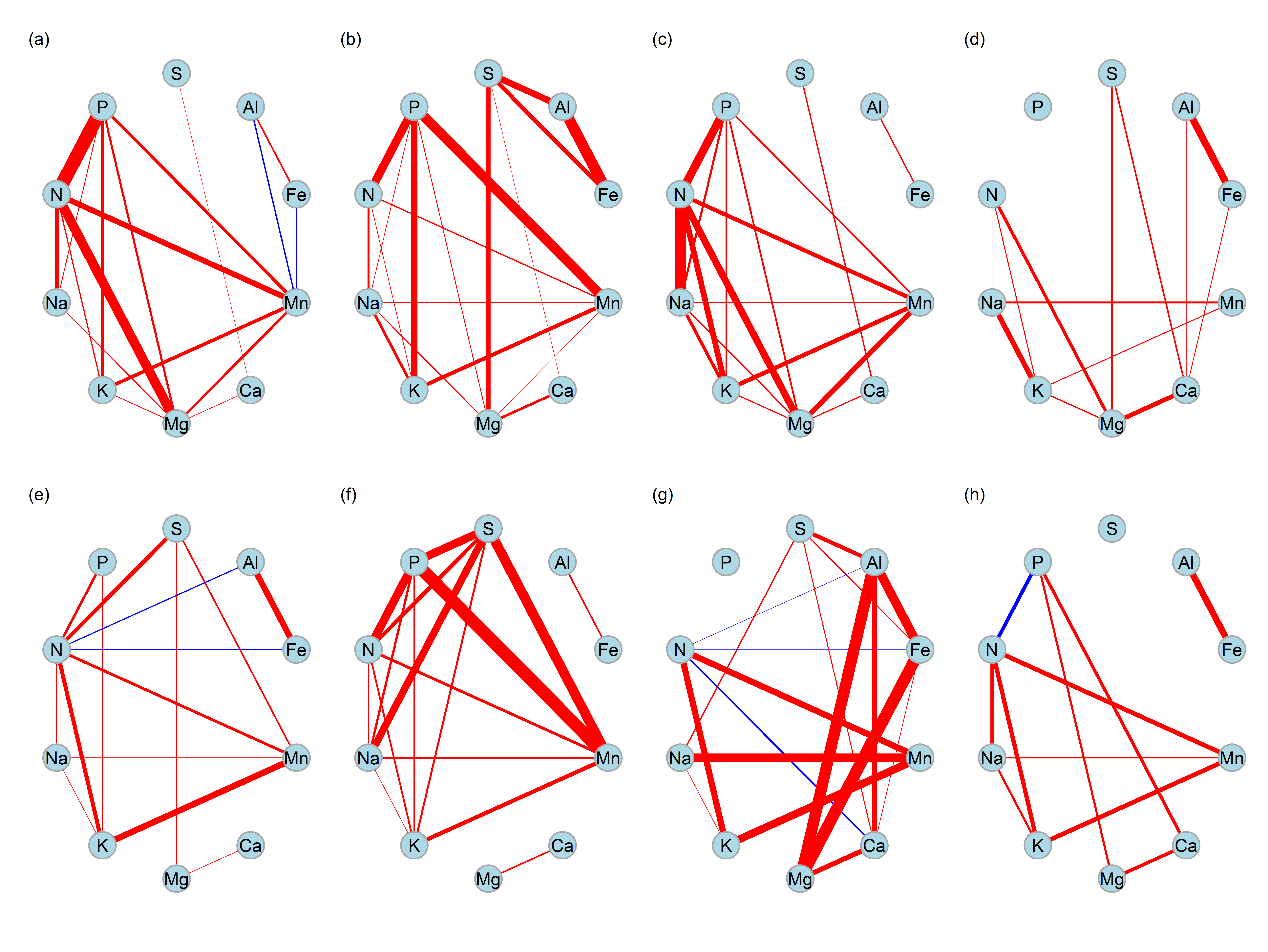
Figure. Network relationships among elements in both EU and AA.(Image by HUANG et al.)
File Download: