Rare-earth mining weakens the nitrogen-sink function of river ecosystems
Reactive nitrogen enrichment is a major pressure on freshwater ecosystems. Rivers can act as nitrogen sinks by permanently removing reactive nitrogen before it is transported downstream, thereby buffering watershed-scale nitrogen pollution. Previous work by the research team showed that, in high-nitrogen urban rivers, coupled nitrification, denitrification, and algal assimilation can partly maintain riverine nitrogen-sink function, although with potential N2O emission risks (Xuan et al., Journal of Hydrology, 2025, 661: 133815).
Rare-earth mining represents a distinct disturbance. In ion-adsorption rare-earth mining regions, residual ammonium from in-situ leaching, rare-earth element mobilization, acidification, and sediment disturbance jointly form REE-rich, high-nitrogen mining drainage (REEs-HNMD). Whether rivers under this combined stress can still maintain nitrogen-sink function remains unclear.
To address this issue, the team studied a typical rare-earth mining watershed, integrating 15N isotope-tracing experiments, nitrate dual isotopes, microbial community analysis, denitrification functional genes, and structural equation modeling. The results showed that denitrification was the dominant pathway for permanent nitrogen removal, whereas anammox contributed little. Sediment denitrification showed a nonlinear response to REEs-HNMD: moderate pollution partly stimulated denitrification by increasing nitrogen substrate availability, whereas high pollution strongly suppressed denitrification through combined rare-earth enrichment, excessive nitrogen input, and sediment disturbance.
The study demonstrates that rare-earth mining drainage is not only a nitrogen source, but also weakens sediment microbial nitrogen-removal processes, reducing the natural buffering capacity of rivers. Mining-affected rivers may therefore shift from “nitrogen-pollution buffers” to “nitrogen-pollution transport corridors”. These findings highlight the need to protect and restore sediment nitrogen-sink function in rare-earth mining watersheds.
The study, entitled “REEs-HNMD weakens riverine N-sink function through suppressed sediment denitrification in a rare-earth mining watershed,” was published in Journal of Hazardous Materials. Associate Researcher XUAN Yingxue is the first author, with guidance from Professor LU Xiankai. This work was supported by the National Natural Science Foundation of China and the National Key R&D Program. Article link: https://doi.org/10.1016/j.jhazmat.2026.142223
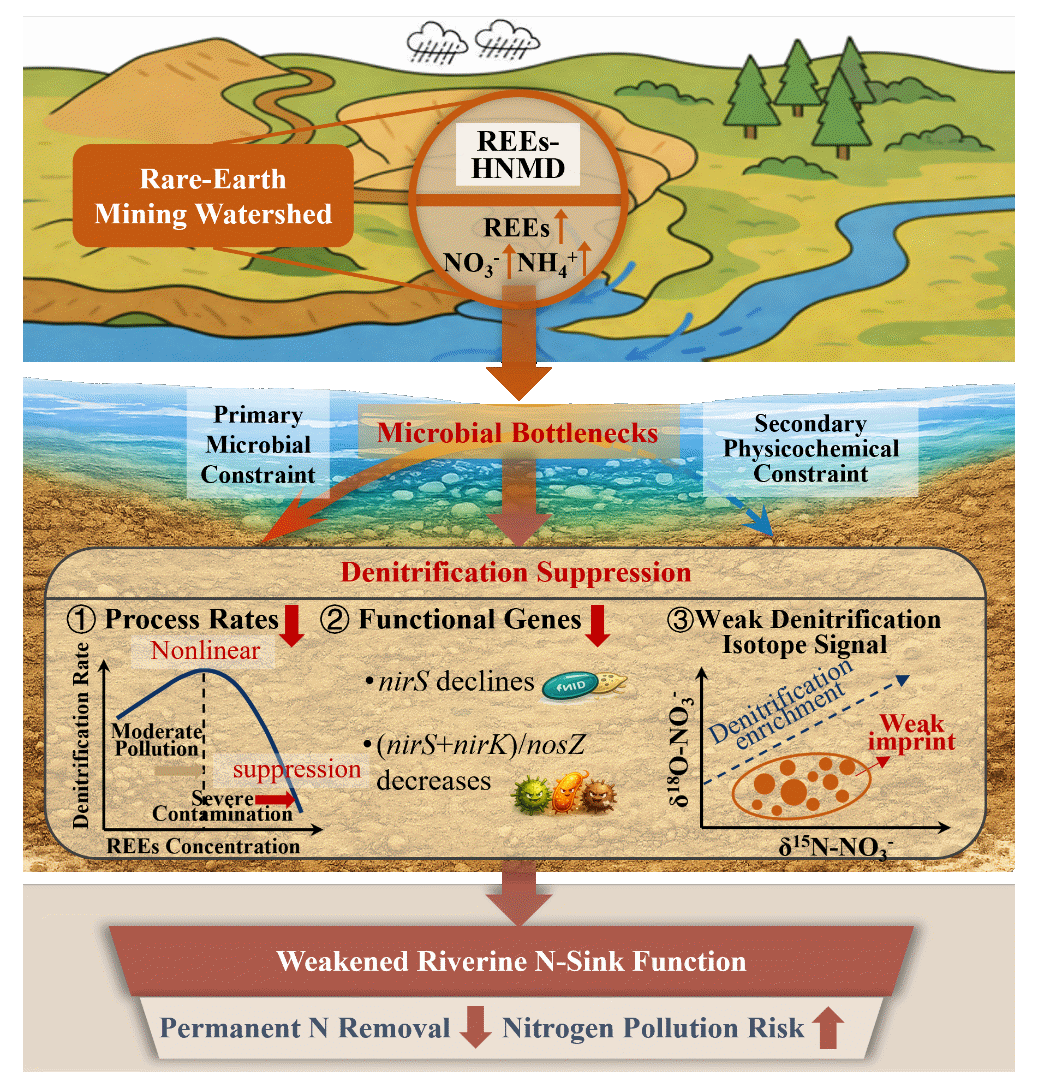
Figure. Conceptual diagram of the effects of REEs-HNMD on riverine nitrogen-sink function.(Image by XUAN et al.)
File Download: