Researchers propose an integrated biomarker-isotope method for credible saltmarsh blue carbon accounting
Saltmarshes are important coastal blue carbon ecosystems that store large amounts of organic carbon in sediments. Yet this carbon does not come from a single source. Some is produced locally by saltmarsh plants, while some is imported from terrestrial or marine systems through riverine and tidal processes. Distinguishing these sources is essential for credible blue carbon accounting and for avoiding potential double counting in carbon credit programs.
To address this challenge, researchers from the South China Botanical Garden, Chinese Academy of Sciences, investigated sedimentary organic carbon sources in two representative Chinese saltmarsh systems: the Yellow River Delta and the Yancheng saltmarshes. The study examined dominant vegetation communities, including Spartina alterniflora, Suaeda salsa, and Phragmites australis, and developed an integrated framework that combines molecular biomarkers with stable isotope validation.The framework uses n-alkanes to identify plant-derived carbon sources, amino sugars to quantify microbial necromass carbon, and δ13C-N/C isotope models to validate source partitioning (Figure 1). This approach enabled the researchers to quantify five major organic carbon sources: autochthonous halophyte carbon, allochthonous terrestrial xylophyte carbon, allochthonous marine algae carbon, fungal necromass carbon, and bacterial necromass carbon.
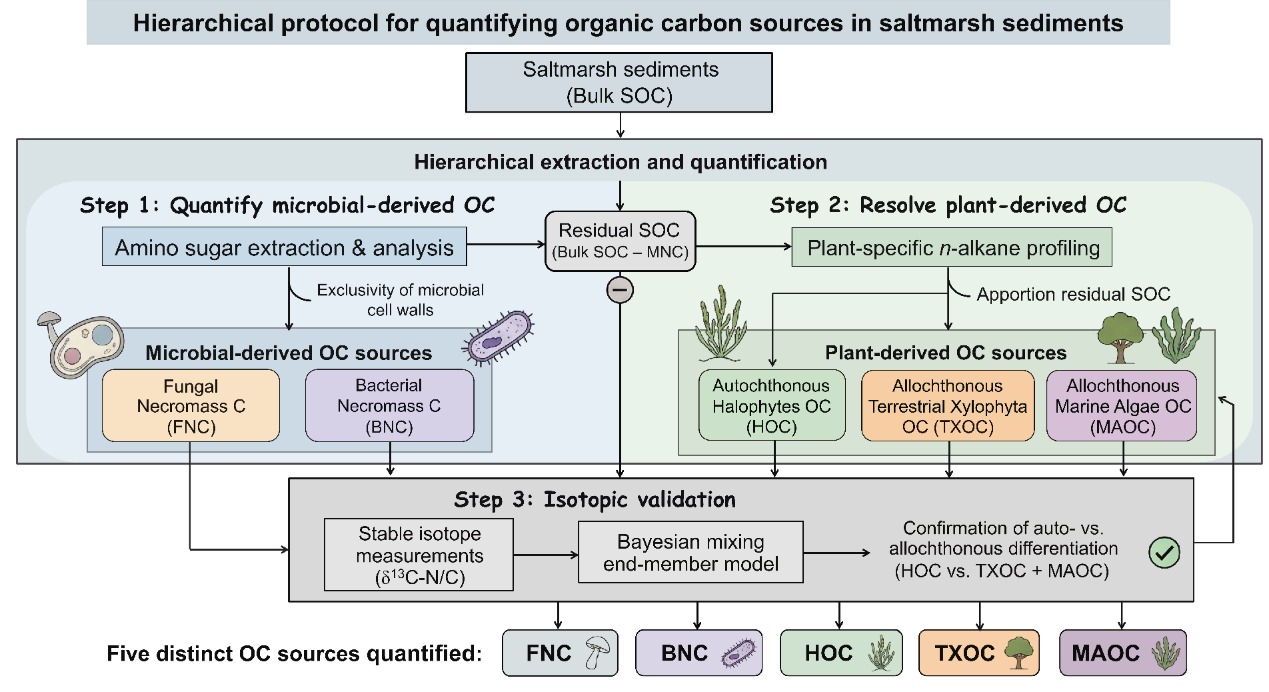
Figure 1. The protocol for quantifying organic carbon sources in saltmarsh sediments.(Image by WANG Faming)
The results show that plant-derived organic carbon dominates saltmarsh sedimentary organic carbon, contributing more than 75% of the total. Local halophyte-derived carbon was the largest individual component, accounting for 36.9% to 58.2%. In contrast, microbial-derived carbon generally contributed no more than 20%, highlighting a carbon accumulation pathway that differs from many terrestrial ecosystems (Figure 2). Soil texture and nutrient conditions were identified as key regulators of plant- and microbial-derived carbon, but they acted through distinct pathways.Stable isotope validation confirmed the reliability of the biomarker-based results. The Yellow River Delta saltmarshes were dominated by autochthonous carbon inputs, whereas the Yancheng saltmarshes showed stronger allochthonous carbon contributions. These regional contrasts suggest that blue carbon accounting should be calibrated to local hydrodynamic conditions, sediment sources, and vegetation types rather than relying on a single generalized parameter set.
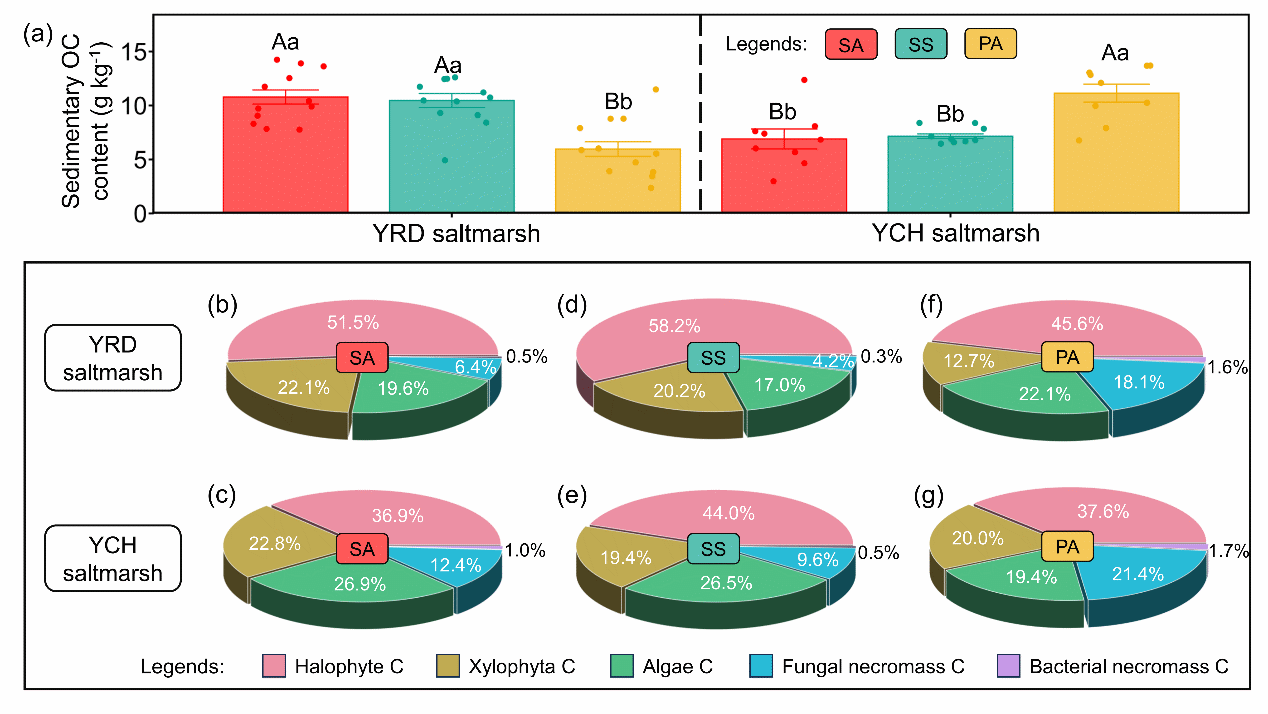
Figure 2. Organic carbon characteristics in the Yellow River Delta and Yancheng saltmarshes.(Image by WANG Faming)
The study provides a methodological basis for improving source-resolved blue carbon accounting in saltmarshes. In systems dominated by local plant inputs, vegetation conservation and restoration may strengthen carbon sequestration potential. In systems with stronger external inputs, management may need to balance local production with sediment stabilization and carbon retention. The framework offers a more traceable approach for linking saltmarsh conservation with climate mitigation, while broader application will require local endmember calibration and uncertainty assessment.
The research findings, entitled "Unravelling Saltmarsh Organic Carbon Sources: Biomarker-Isotopic Integration for Credible Blue Carbon Accounting", have been published by CATENA. ZHOU Jinge, a doctoral student at the South China Botanical Garden, is the first author of the paper. Professor WANG Faming is the corresponding author. This study was supported by the National Natural Science Foundation of China, the National Key R&D Program of China, the CAS Project for Young Scientists in Basic Research, the Guangdong Basic and Applied Basic Research Foundation, the CAS Youth Innovation Promotion Association, the National Forestry and Grassland Administration Youth Talent Support Program, ANSO. Article link:https://doi.org/10.1016/j.catena.2026.110344
File Download: