Microbial Control Over Blue Carbon During Mangrove Restoration
A research team from the South China Botanical Garden, Chinese Academy of Sciences, has identified microbial carbon limitation as an important regulator of blue carbon outcomes during mangrove restoration. The study shows that restoration not only increases soil organic carbon (SOC), but also changes the source composition and potential biochemical quality of the restored carbon pool. The findings were published online in Catena.
Mangrove SOC accumulation is jointly controlled by plant inputs, microbial transformation and nutrient supply. However, how microbial metabolic limitation affects the balance between plant-derived and microbial-derived carbon during restoration has remained poorly understood. The researchers compared degraded mudflats with restored stands of Sonneratia apetala and Kandelia obovata on Qi'ao Island, Zhuhai. They combined extracellular-enzyme stoichiometric vector analysis, lignin-phenol and amino-sugar biomarkers, microbial community analysis, random forests and structural equation modelling.
The degraded mudflat soils were co-limited by carbon and phosphorus. Following mangrove restoration, microbial carbon limitation was strongly reduced and was no longer detected in either restored forest type, whereas phosphorus limitation persisted. Available nutrients and soil carbon quality exerted stronger control over microbial carbon limitation than microbial life-history strategies, with SOC, total nitrogen and the ratio of labile to recalcitrant carbon emerging as key predictors.
Restoration increased the absolute abundance of both lignin phenols, used as indicators of plant-derived carbon, and amino sugars, used as indicators of microbial necromass. When standardized by SOC, however, the restored soils showed a higher relative contribution of plant-derived carbon and a lower relative contribution of microbial-derived carbon. The findings therefore indicate that restoration changes not only how much carbon is stored, but also what types of carbon accumulate. Although the study did not directly measure long-term persistence, it identifies microbial carbon limitation as a key link between restoration, SOC accumulation and blue carbon source composition.
The authors suggest that microbial carbon limitation, phosphorus availability and biomarker-based indicators of carbon sources should be incorporated into mangrove restoration monitoring. These indicators could improve evaluation of carbon-sequestration outcomes and support more targeted blue carbon management. Dr. HUANG Xingyun, a postdoctoral researcher in Prof. Faming Wang's team, is the first author, and Prof. WANG Faming is the corresponding author. The study was supported by the National Natural Science Foundation of China, the National Key Research and Development Program of China, and the EU-China C-BLUES collaborative project, among other sources. Article link: https://doi.org/10.1016/j.catena.2026.110296
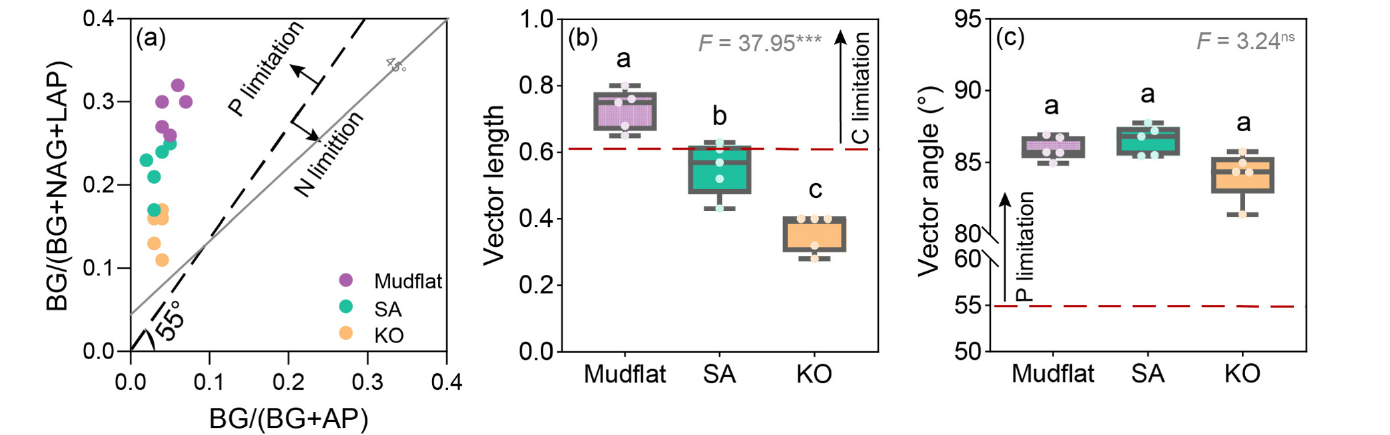
Figure 1. Mangrove restoration markedly relieved microbial carbon limitation, whereas phosphorus limitation persisted across degraded and restored sites.(Image by WANG Faming)
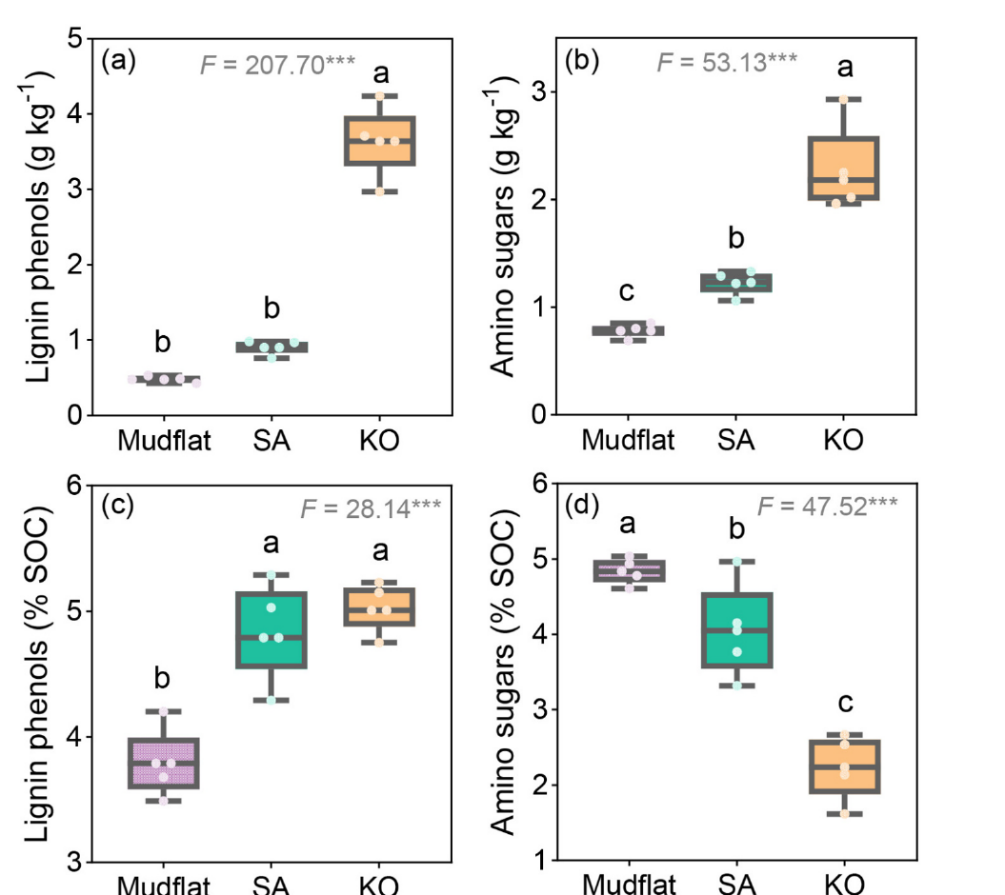
Figure 2. Restoration increased the absolute contents of lignin phenols and amino sugars, while SOC-normalized values indicated a higher relative contribution of plant-derived carbon and a lower relative contribution of microbial necromass.
(Image by WANG Faming)
File Download: