A novel mechanism by which mixed-species afforestation enhances the multifunctionality of degraded tropical soils
Afforestation is a key strategy for restoring degraded ecosystems and mitigating climate change. However, previous assessments have focused on vegetation recovery or individual soil functions, leaving a gap in understanding how different afforestation models jointly influence nutrient supply, enzyme activity, and microbial metabolism—collectively termed soil multifunctionality. The molecular composition and diversity of soil organic carbon (SOC), which may shape microbial processes and nutrient cycling, have been particularly underexplored.
The Restoration Ecology Team at Heshan Station, Chinese Academy of Sciences (CAS), reveals that mixed-species afforestation significantly improves soil multifunctionality in tropical degraded lands. The team conducted the research at the Xiaoliang Tropical Coastal Ecosystem Research Station, CAS, using a restoration sequence comprising a bare land, a Eucalyptus monoculture, a secondary mixed-species forest, and an old-growth natural forest. They measured 13 soil functional indicators associated with soil nutrient content, microbial biomass, carbon use efficiency, and hydrolytic enzyme activities. Advanced techniques such as phospholipid fatty acid analysis, GeoChip functional gene microarrays, and pyrolysis GC-MS were employed to disentangle relationships among plant communities, soil microbes, SOC molecular composition, and soil multifunctionality.
The study showed that afforestation significantly improved soil nutrient supply and enzyme activity, even though microbial carbon use efficiency declined. Overall, afforestation markedly enhanced soil multifunctionality, with the secondary mixed-species forest outperforming the Eucalyptus monoculture. Mixed planting promoted microbial community reassembly and functional potential: microbial biomass and diversity increased, and functional genes related to recalcitrant carbon degradation, nitrogen fixation, ammonification, denitrification, and organic phosphorus hydrolysis were notably enriched. The microbial functional gene network also expanded in scale and connectivity, reflecting improved functional coordination.
A pivotal discovery was that SOC molecular diversity serves as a critical "biochemical bridge" linking microbial attributes to soil multifunctionality. Following afforestation, nitrogen-containing compounds, lignin-derived molecules, phenolics, and carbohydrates increased, with SOC molecular diversity significantly higher than in the bare land. Path analysis confirmed that microbial community and functional attributes connect to soil multifunctionality through SOC molecular diversification, supporting the synergistic enhancement of multiple soil processes.
The study suggests that ecological restoration of tropical degraded lands should go beyond counting trees planted or carbon stocks gained. It should prioritize mixed-species configurations, belowground microbial functional organization, and synergistic optimization of SOC molecular diversity. For future plantation and restoration practices, multi-species mixed planting should be prioritized, and SOC molecular diversity should be incorporated into restoration evaluation systems to maximize long-term ecological benefits.
The article titled by "Mixed-species afforestation enhances soil multifunctionality through microbial reassembly and SOC molecular diversification" was published in the Journal of Applied Ecology. Dr. LI Yue is the first author, and Professor LIU Zhanfeng is the corresponding author. The study was supported by the National Natural Science Foundation of China and the Guangdong Science and Technology Plan Project. Article link: https://doi.org/10.1111/1365-2664.70509
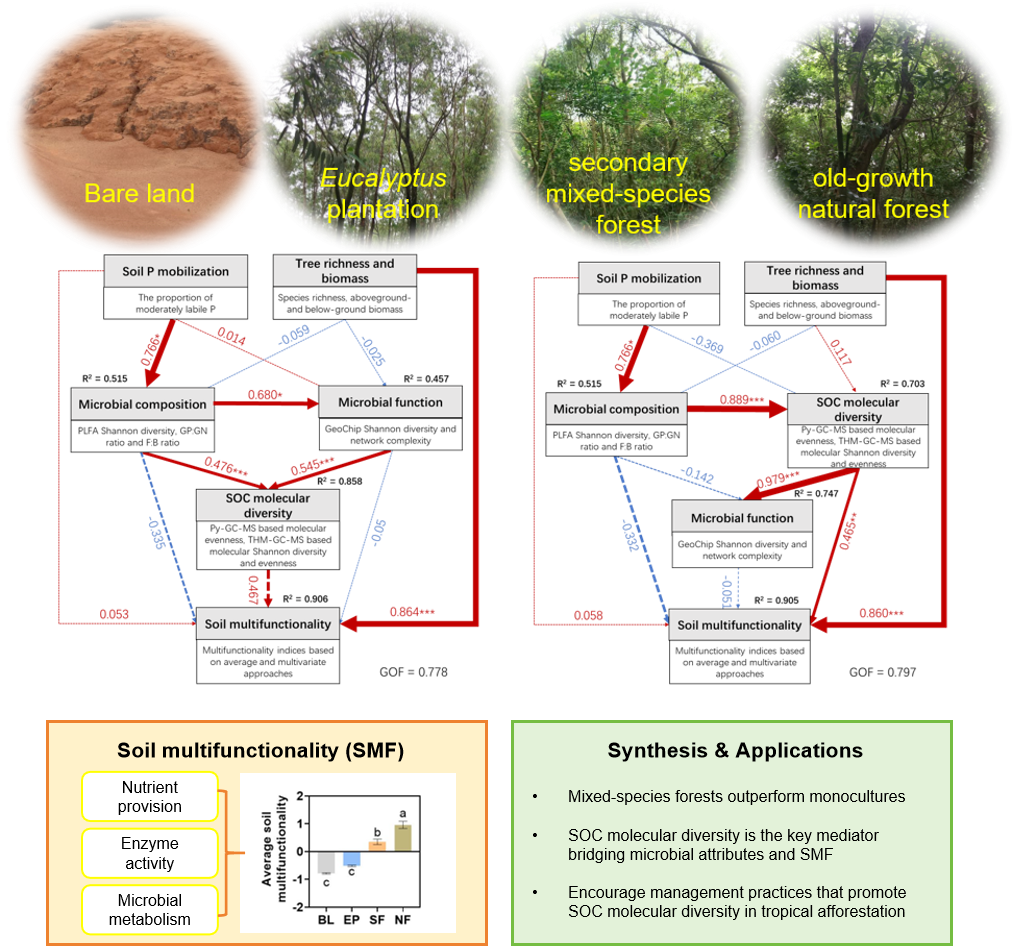
Figure. Mixed-species afforestation consistently enhances soil multifunctionality through microbial reassembly and SOC molecular diversification.(Image by LI Yue)
File Download: