Light Environment Regulates Isoflavonoid Biosynthesis in Soybean Seeds
Isoflavonoids are an important class of secondary metabolites in soybean. They not only participate in physiological processes such as plant disease resistance, microbial interactions, abiotic stress responses, and nodule formation, but also have significant nutritional and health value for humans. Although the molecular mechanisms underlying isoflavonoid biosynthesis in soybean seeds have been studied to some extent, it remains unclear how changes in the light environment caused by seasonal variation regulate seed isoflavonoid content in natural settings.
Recently, the South China Botanical Garden, Chinese Academy of Sciences, published a research paper in The Plant Cell titled "Photoperiod and UV-B orchestrate ICR1 to control seed isoflavonoid accumulation in soybean". Using natural populations, the study identified a key gene, ICR1, that regulates isoflavonoid content in soybean seeds. Further investigation revealed that photoperiod signals regulate isoflavonoid accumulation through the GmCOL2b-ICR1 molecular module, whereas UV-B radiation promotes ICR1 accumulation by enhancing ICR1 protein stability. Therefore, this study not only provides valuable genetic resources for the genetic improvement of soybean quality, but also elucidates the molecular mechanism by which shortening photoperiod and changing UV radiation synergistically promote isoflavonoid accumulation in soybean seeds during the summer-to-autumn seasonal transition.
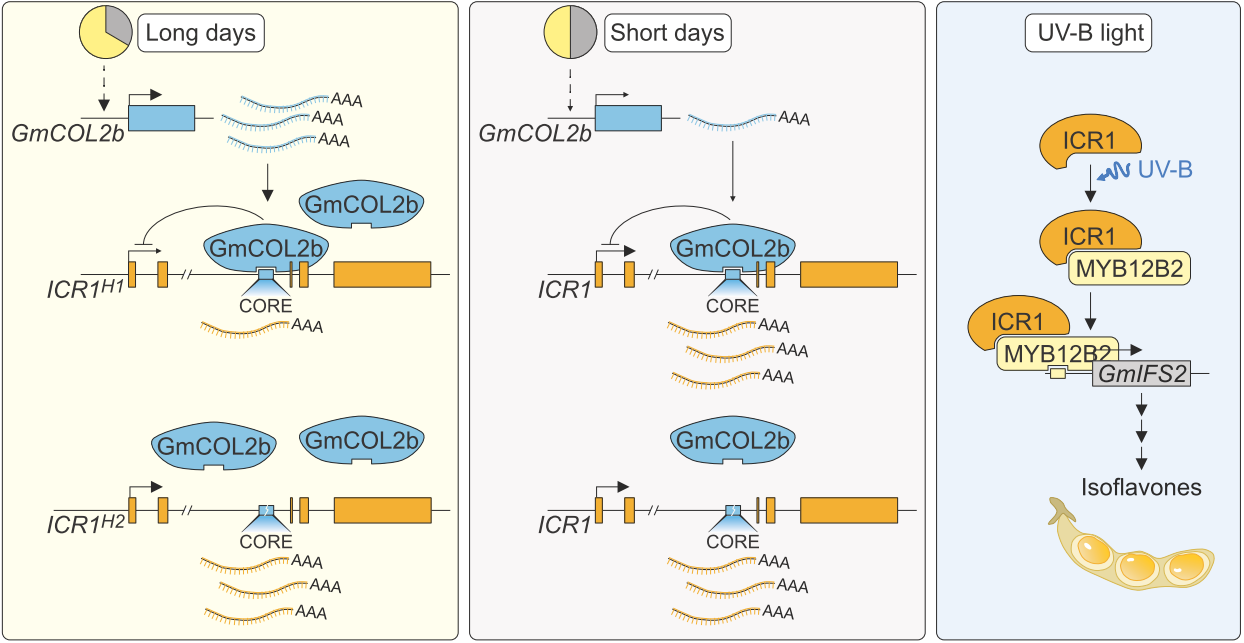
Figure. A molecular model illustrating the regulation of isoflavonoid accumulation in soybean seeds by the light environment.(Image by ZHANG Chunyu)
HOU Xingliang’s team has been dedicated to research on soybean seed development and environmental adaptability, achieving several important milestones (Liu et al., PNAS, 2025; Zhang et al., Nature Communications, 2025; Li et al., Molecular Plant, 2024; Yu et al., Nature Plants, 2023). This study further reveals the molecular mechanism by which the light environment promotes the accumulation of secondary metabolites in soybean seeds. The paper was co-first authored by postdoctoral researcher JIAN Mingyang and doctoral student WU Huan, with Professor HOU Xingliang and Associate Professor ZHANG Chunyu serving as co-corresponding authors. This research was supported by the Natural Science Foundation of Guangdong Province, the National Natural Science Foundation of China, and the National Key Research and Development Program. Article link: https://doi.org/10.1093/plcell/koag268
File Download: