Reveals Early Effects of Tree Species Diversity on Soil Fungal Necromass
Afforestation is an important strategy for restoring degraded ecosystems and strengthening terrestrial carbon sinks. However, in temperate regions, how soil carbon and nitrogen pools change during the early stages of afforestation, and when tree species diversity and mycorrhizal types begin to influence belowground carbon processes, remain poorly understood because long-term observations covering the entire soil profile are scarce. Microbial necromass is a major component of soil organic matter and may respond to vegetation restoration earlier than total soil carbon and nitrogen.
A research team from the Restoration Ecology Research Group at the South China Botanical Garden, Chinese Academy of Sciences, in collaboration with the German Centre for Integrative Biodiversity Research (iDiv) Halle-Jena-Leipzig and Leipzig University, conducted a nearly 10-year study across the 0–100 cm soil profile at the MyDiv tree diversity experiment in Germany. The researchers systematically examined temporal and vertical changes in soil carbon, nitrogen, and microbial necromass across tree communities differing in species richness and mycorrhizal composition.
The results revealed asynchronous and vertically stratified changes in soil carbon, nitrogen, and microbial necromass during early temperate afforestation. Over the first decade, concentrations of total carbon, total nitrogen, and microbial necromass across the 1 m soil profile decreased by approximately 3%, 17%, and 14%, respectively. During the first five years, total nitrogen declined primarily in the 0–40 cm soil layer, whereas total carbon and microbial necromass remained relatively stable. Thereafter, total carbon decreased mainly at 5–40 cm depth, while microbial necromass declined throughout the soil profile. These findings show that soil carbon, nitrogen, and microbial necromass do not change synchronously during early afforestation, but instead follow distinct temporal trajectories and undergo pronounced vertical reorganisation.
Importantly, the effects of tree species diversity emerged in microbial necromass before becoming detectable in total soil carbon and nitrogen. Over the 10-year period, tree species richness and mycorrhizal composition had not yet significantly altered total soil carbon or nitrogen concentrations, but they had already affected microbial necromass, particularly fungal necromass. In mixed communities containing both arbuscular mycorrhizal (AM) and ectomycorrhizal (ECM) tree species, microbial and fungal necromass in the topsoil were 21–27% higher in four-species plots than in two-species plots. Approximately 10 years after planting, fungal necromass was also about 24% higher in four-species than in single-species ECM communities.
These findings suggest that biodiversity effects on soil organic matter formation may develop gradually, with microbial processes responding before measurable changes become evident in total soil carbon pools. Fungal necromass may therefore provide a sensitive early indicator of belowground responses to tree species diversity.
The study advances understanding of biodiversity effects on belowground carbon dynamics during early temperate afforestation and provides new insights for plantation restoration and soil carbon monitoring. The findings also highlight that short-term observations restricted to topsoil, or assessments based solely on total soil carbon, may overlook important early effects of tree species diversity belowground. Incorporating deep-soil sampling, mycorrhizal functional types, and microbial necromass into long-term monitoring programmes could therefore provide a more comprehensive assessment of soil carbon dynamics during forest restoration.
The results further suggest that increasing tree species diversity and combining tree species with contrasting mycorrhizal associations can influence microbial pathways involved in soil organic matter formation, potentially contributing to long-term soil carbon sequestration. Because the study was conducted at a single temperate experimental site, however, further long-term and cross-site studies are needed to determine whether these patterns apply broadly across temperate, subtropical, and tropical forests.
This work was recently published in the international journal Plant and Soil. Dr. LI Tengteng, Postdoctoral Researcher at the South China Botanical Garden, is the first author. Prof LIU Zhanfeng and Prof Nico Eisenhauer are co-corresponding authors. The research was supported by the National Natural Science Foundation of China and the Guangdong Provincial Basic and Applied Basic Research Programme. Article link: https://doi.org/10.1007/s11104-026-09082-6
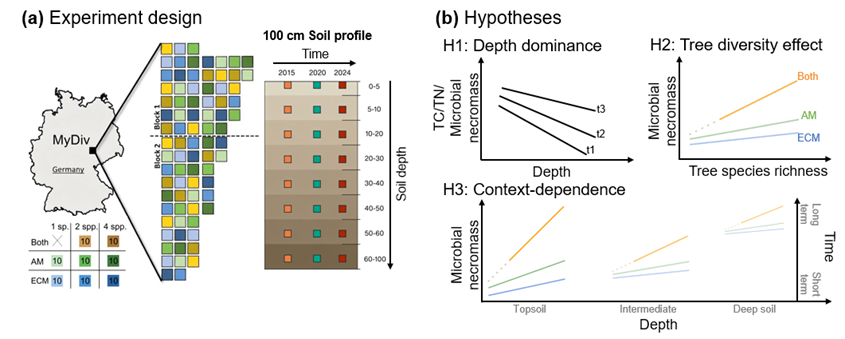
Fig. 1. Experimental design and research hypotheses.(Image by LI Tengteng)
(a) Experimental design. The MyDiv tree diversity experiment was established in 2015 in Bad Lauchstädt, Germany. It comprises three levels of tree species richness (1, 2, and 4 species) and three mycorrhizal compositions: arbuscular mycorrhizal only (AM), ectomycorrhizal only (ECM), and mixed AM + ECM (Both). The experiment uses a randomised block design with two blocks and 80 plots in total. Soil samples were collected in 2015, 2020, and 2024 and divided into eight depth intervals: 0–5, 5–10, 10–20, 20–30, 30–40, 40–50, 50–60, and 60–100 cm. (b) Research hypotheses. H1: Total carbon (TC), total nitrogen (TN), and microbial necromass show divergent vertical patterns over time, with TN declining earlier and affecting deeper soil layers than TC. H2: Increasing tree species richness promotes microbial necromass accumulation; these effects are modulated by mycorrhizal composition and are strongest in mixed AM + ECM communities, followed by AM and then ECM communities. H3: Tree species richness and mycorrhizal composition jointly influence fungal necromass accumulation and its early temporal dynamics, resulting in depth-dependent changes in the fungal-to-bacterial necromass ratio.
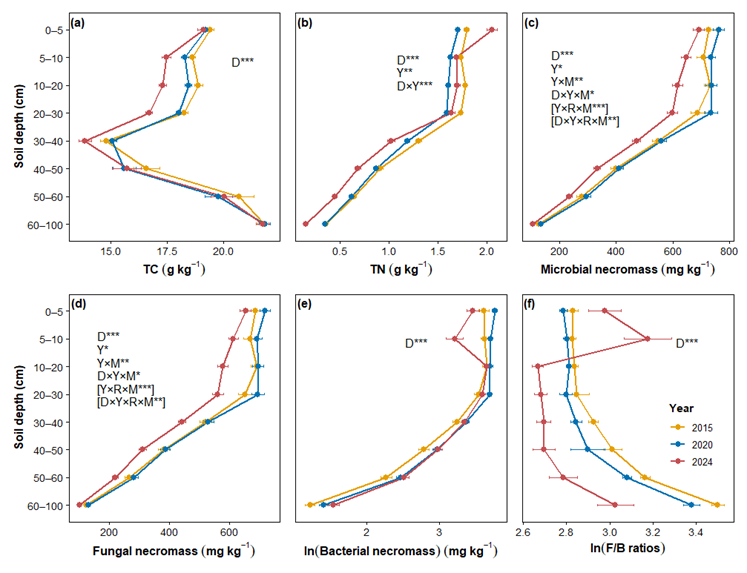
Fig. 2.Vertical distribution of total carbon (TC), total nitrogen (TN), microbial necromass, and the fungal-to-bacterial necromass ratio across the 0–100 cm soil profile in 2015, 2020, and 2024. Curves show means ± standard error (SE). Linear mixed-effects models were used to test the effects of soil depth (D), year (Y), mycorrhizal type (M), and tree species richness (R). Significance is indicated as follows: P < 0.05, P < 0.01, and P < 0.001. Interactions involving richness or mycorrhizal type are shown in parentheses to distinguish treatment-related interactions from the primary temporal and depth effects.(Image by LI Tengteng)
File Download: