Study Finds Earlier and Faster Heatwave Onset on Land Under a Warming Climate
Heatwaves over land worldwide are beginning earlier, ending later and occurring over longer seasons, while the first heatwave of the season has recently shifted toward faster onset, according to a new study led by researchers from the South China Botanical Garden (SCBG) of the Chinese Academy of Sciences (CAS). The findings, published in Nature Climate Change, show that global warming is changing not only how frequent, intense and persistent heatwaves are, but also when they occur and how rapidly they develop.
Previous studies have largely focused on heatwave frequency, intensity and duration, while long-term changes in heatwave timing and onset speed have received less attention. Using global climate data from 1979 to 2023, the research team examined changes in the onset and ending dates of seasonal heatwaves, heatwave season length, and the onset speed of each season’s first heatwave. The findings were cross-validated against multiple independent climate datasets.
The researchers found that, on average, the first heatwave began 3.29 days earlier per decade, while the last heatwave ended 5.41 days later per decade, extending the heatwave season by 8.71 days per decade. Over the 45-year study period, the first heatwave advanced by about two weeks, the last heatwave was delayed by about 24 days, and the heatwave season lengthened by about 39 days. Across global land aeras, 72 percent of global land areas showed a trend toward earlier heatwave onset, 79.6 percent toward later ending, and 92.1 percent toward longer heatwave seasons, with generally greater changes observed in drylands.
The researchers also classified the first heatwave of each season into rapid-, moderate- and slow-onset categories based on the relative timing of the temperature peak within each event. From 2001 to 2023, the proportion of rapid-onset first heatwaves within heatwave-affected land areas increased significantly, indicating a recent shift toward faster heatwave onset. The finding suggests that heatwave risks depend not only on how hot the events become and how long they last, but also on when they arrive and how quickly they reach peak temperatures.
The study broadens understanding of global heatwave change by highlighting heatwave timing and development speed as additional dimensions of risk. It also found that longer heatwave seasons are expanding crop exposure to extreme heat. From 2001 to 2023, the proportion of crop areas exposed to heatwaves during critical reproductive stages, such as flowering and silking, increased by 1.6 percent to 13.3 percent for several major crops compared with 1979–2000. Heatwave exposure also extended into earlier and later stages of crop development.
“In the past, we have mostly focused on whether heatwaves are becoming more frequent, stronger and longer. Our study further shows that their timing and onset speed are also changing. If heatwaves arrive earlier and develop more rapidly, the time available for societies and ecosystems to prepare and adapt could become even shorter,” said XU Wenfang of SCBG, the study’s first author and one of its corresponding authors.
The findings offer new scientific evidence for strengthening extreme-heat monitoring and early warning. The researchers noted that, alongside temperature intensity and duration, when heatwaves begin and end and how rapidly they develop could also be considered in heat monitoring and risk assessment. Such information could improve understanding of evolving heat risks and support early-warning and adaptation measures across public health, agriculture, ecosystem management and energy supply.
XU Wenfang of SCBG, CAS, is the first author of the study. XU Wenfang and LIU Juxiu, both of SCBG, CAS, and YUAN Wenping of Peking University are the corresponding authors. Other co-authors include WU Donghai of SCBG, CAS; Philippe Ciais of the Laboratoire des Sciences du Climat et de l'Environnement (LSCE); WANG Ying-Ping of Monash University; and HUANG Mengtian of the Chinese Academy of Meteorological Sciences. Article link: https://doi.org/10.1038/s41558-026-02762-2
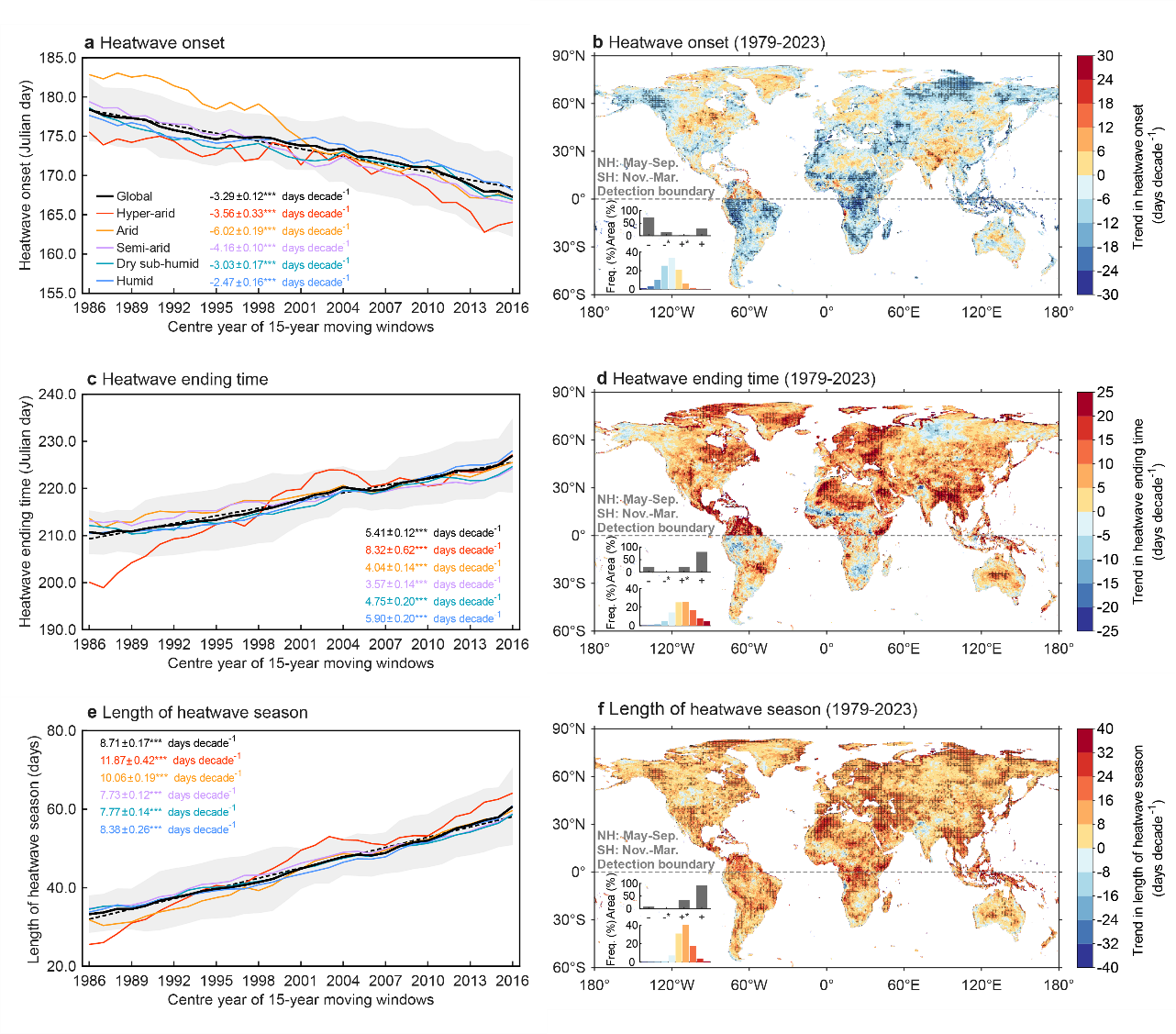
Fig. Changes in heatwave onset, ending time and season length across global land areas during 1979-2023.(Image by Xu)
File Download: