Novel Mechanism by Which DNA Viruses Hijack Host Deubiquitinases UBP12/13 to Promote Viral Infection
Plant DNA viruses, including double-stranded DNA viruses (e.g., caulimoviruses) and single-stranded DNA viruses (e.g., geminiviruses), are devastating crop pathogens. Upon infection, viral genomes are packaged with host histones to form minichromosomes. Histone post-translational modifications (PTMs) play critical roles in viral replication and host defense. Hosts can transcriptionally repress viral minichromosomes through histone modifications; however, how viruses counteract this chromatin-based defense mechanism remains largely unclear.
Recently, a research team from the South China Botanical Garden, Chinese Academy of Sciences, in collaboration with the Temasek Life Sciences Laboratory, Singapore, published a study in PLOS Pathogens titled “The pathogenicity factor of DNA virus interacts with Arabidopsis deubiquitinases UBP12/13 to promote viral infection”. The study reveals that plant DNA viruses hijack the host deubiquitinases UBP12/13 via their pathogenicity factor P6 to remodel the epigenetic landscape of viral minichromosomes, thereby relieving host epigenetic silencing and promoting infection. This work identifies UBP12/13 as potential novel targets for engineering virus-resistant crops.
Using affinity purification-mass spectrometry (AP-MS), the researchers screened for host proteins interacting with the CaMV pathogenicity factor P6 and identified the Arabidopsis deubiquitinases UBP12 and UBP13 as prominent P6 interactors. A series of assays, including yeast two-hybrid (Y2H), pull-down, co-immunoprecipitation (Co-IP), and bimolecular fluorescence complementation (BiFC), confirmed that P6 directly interacts with UBP12 and UBP13 in the nucleus through the MATH domain of UBP12/13.
Genetic and phenotypic analyses showed that ubp12/13 mutants exhibited significantly enhanced resistance to CaMV, with delayed disease progression and markedly reduced accumulation of viral DNA and transcripts. In contrast, UBP12/13 overexpression lines displayed more severe symptoms and higher viral loads. Further functional validation demonstrated that the deubiquitinase activity of UBP12 is required for its pro-viral function; a catalytic-dead C/S mutant lost the ability to promote viral infection.
UBP12/13 are known to deubiquitinate monoubiquitinated H2A (H2Aub). Chromatin immunoprecipitation-qPCR (ChIP-qPCR) revealed that UBP12/13 specifically modulate the histone modification status at the viral 35S promoter, reducing the repressive marks H2Aub and H3K27me3, thus relieving transcriptional repression of the viral genome.
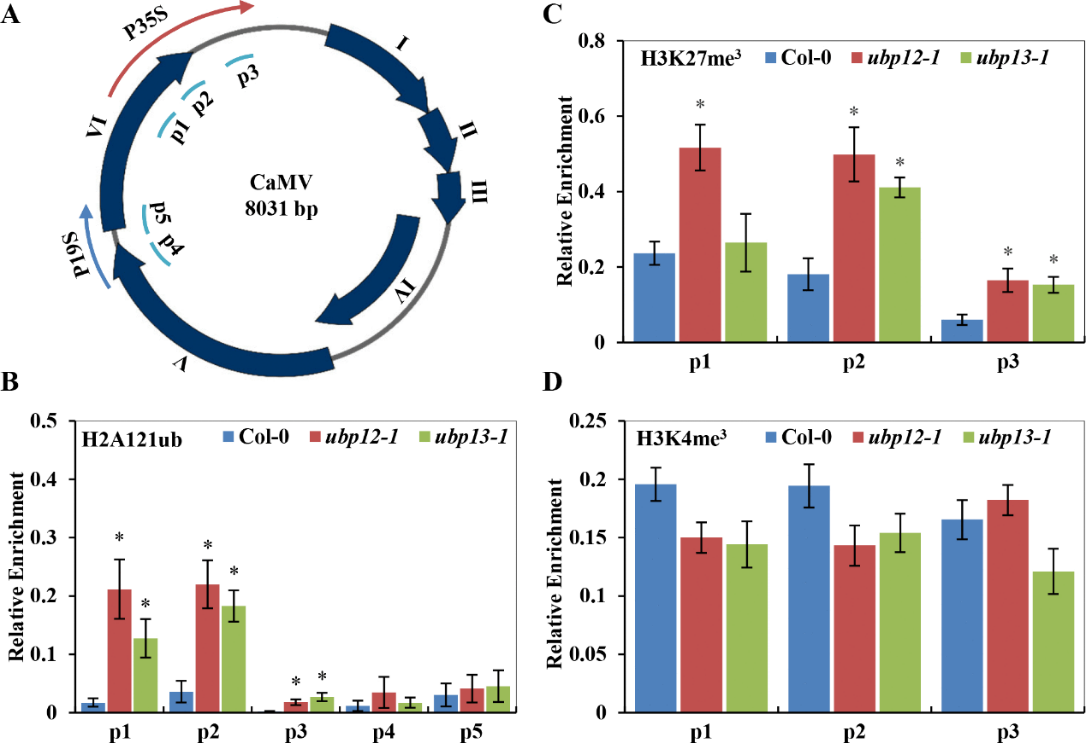
Fig 1. UBP12/13 affect H2Aub and H3K27me3 enrichment on CaMV minichromosomes.(Image by LI Shun)
Importantly, the pathogenicity factor AC2 of the geminivirus Cabbage leaf curl virus (CaLCuV) also targets UBP12/13 in the nucleus, and ubp12/13 mutants showed enhanced resistance to CaLCuV. This indicates that hijacking UBP12/13 is a conserved infection strategy among diverse plant DNA viruses.
Based on these findings, the authors propose a working model: In wild-type plants, the viral pathogenicity factor P6/AC2 enters the nucleus and interacts with UBP12/13. UBP12/13 then remove H2Aub and reduce H3K27me3 levels at the 35S promoter of the viral minichromosome, alleviating host epigenetic silencing and allowing robust viral transcription and replication. In ubp12/13 loss-of-function mutants, elevated H2Aub and H3K27me3 persist at the 35S promoter, leading to sustained transcriptional repression of the virus and enhanced plant resistance. This study elucidates a previously unrecognized mechanism by which plant DNA viruses manipulate host epigenetic machinery to promote infection.
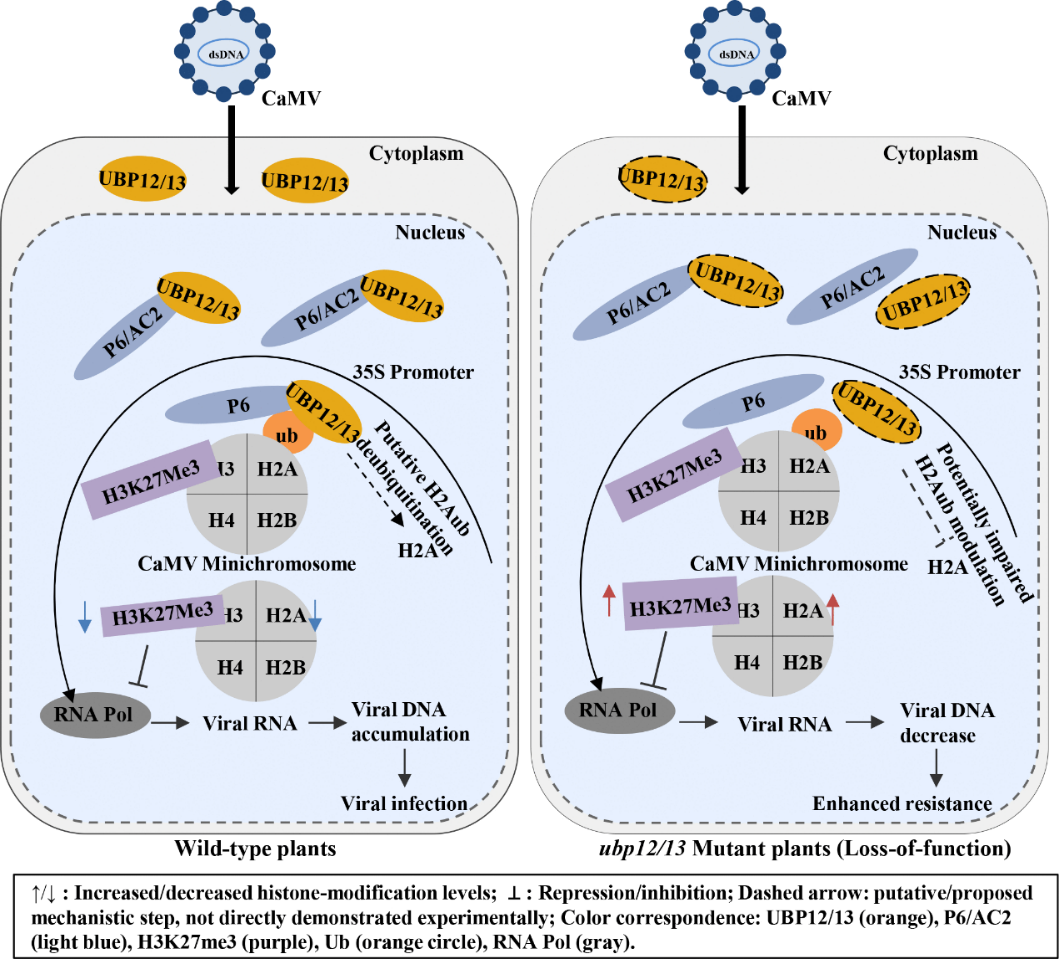
Fig 2. Proposed working model illustrating how CaMV P6 exploits UBP12/13 to alleviate host epigenetic silencing and promote viral infection.(Image by LI Shun)
LI Shun (former Ph.D. graduate) and YU Fangqin (postdoc) from the South China Botanical Garden are co-first authors of this paper. DENG Shulin (Research Professor, South China Botanical Garden), Nam-Hai Chua (Professor, Temasek Life Sciences Laboratory), and Hui-Wen Wu (Ph.D.,Republic Polytechnic, Singapore) are corresponding authors. ZHANG Yi (Associate Researcher) and LIU Siqi (M.Sc. student) from the South China Botanical Garden also contributed to this work. The study was supported by grants from the National Natural Science Foundation of China and the Guangdong Science and Technology Plan Project.Full article link:https://doi.org/10.1371/journal.ppat.1014686
File Download: