Breakthrough in Alfalfa Breeding at South China Botanical Garden: AtFLZ13 Enhances High Yield and Heat-Humidity Tolerance in Alfalfa to Advance the “North‑to‑South Forage Transfer” Strategy
Alfalfa (Medicago sativa L.) is the world’s most widely planted high‑quality perennial leguminous forage, delivering remarkable economic and ecological benefits. In China, alfalfa is predominantly grown in arid and semi‑arid northern regions. In southern China, however, hot summers coupled with frequent heavy rainfall severely hamper the growth of introduced alfalfa varieties, frequently triggering premature leaf senescence and abscission, yield loss, and frequent pest and disease outbreaks. Resolving the growth‑stress resistance trade‑off under combined heat‑humidity stress while maintaining high biomass accumulation and forage quality represents a critical scientific challenge and industrial bottleneck for alfalfa breeding in southern China.
The FLZ (FCS‑Like Zinc Finger) family genes encode zinc‑finger proteins unique to land plants, which are broadly involved in plant development and stress responses. Previous work from Yang’s team showed that the Arabidopsis thaliana AtFLZ13 gene regulates flowering time, ABA signaling and autophagy (Mol Plant. 2023;16(7):1192–1211; Plant Commun. 2023;4(6):100636; New Phytol. 2024;241(3):1334–1347), with pleiotropic functions governing plant growth, development and stress adaptation. Four national invention patents have been authorized for related genes and technologies, making AtFLZ13 an attractive molecular target for genetically improving stress resistance of forages.
In this study, novel alfalfa germplasm overexpressing Arabidopsis AtFLZ13 was generated via genetic engineering. The findings confirm that AtFLZ13 can be deployed to breed high‑yield, heat‑humidity‑tolerant alfalfa, overcoming the shortage of elite breeding targets in this research field. Unlike conventional genetic modification, which often improves stress tolerance at the cost of plant growth, heterologous overexpression of AtFLZ13 achieves simultaneous gains in stress resistance and yield. Following heat‑humidity stress treatment, the survival rate of transgenic lines rose from 15 % in the control cultivar Zhongmu No. 1 to over 60 %. Under greenhouse conditions, transgenic plants exhibited significant increases in plant height, leaf count and leaf area, with above‑ground fresh and dry biomass increased by 50 %‑100 %. Physiological and transcriptomic analyses reveal that AtFLZ13 alleviates oxidative damage by coordinately up‑regulating 13 POD and other genes, while activating 10 glycoside hydrolase genes to boost soluble‑sugar accumulation. Together these establish a synergistic defense system combining oxidative damage mitigation and osmotic adjustment. Furthermore, two‑year field trials spanning 2025 and 2026 were carried out in Guangzhou, a representative hot‑humid ecological site in South China, covering two and three cutting‑regrowth cycles respectively. Continuous field monitoring verified that transgenic lines maintain pronounced and sustained growth and agronomic yield advantages even under extreme midsummer combined stress of continuous heavy rainfall and high temperature. This work provides practically applicable gene and germplasm resources to promote China’s “North‑to‑South Forage Transfer” strategy for premium alfalfa.
The article entitled Engineering transgenic alfalfa with improved biomass and enhanced heat‑humidity tolerance has been published in Plant Physiology. Associate Researcher YANG Chao, graduated master’s student LI Jing, and Assistant Researcher LI Yuping from the Horticultural Science Research Center, South China Botanical Garden, Chinese Academy of Sciences, are co‑first authors. Associate Researcher YANG Chao and Researcher WANG Ying serve as corresponding authors. This work was supported by grants from the Youth Innovation Promotion Association, Chinese Academy of Sciences and the Tip-top Scientific and Technical Innovative Youth Talents of Guangdong Special Support Program. Paper link: https://doi.org/10.1093/plphys/kiag754
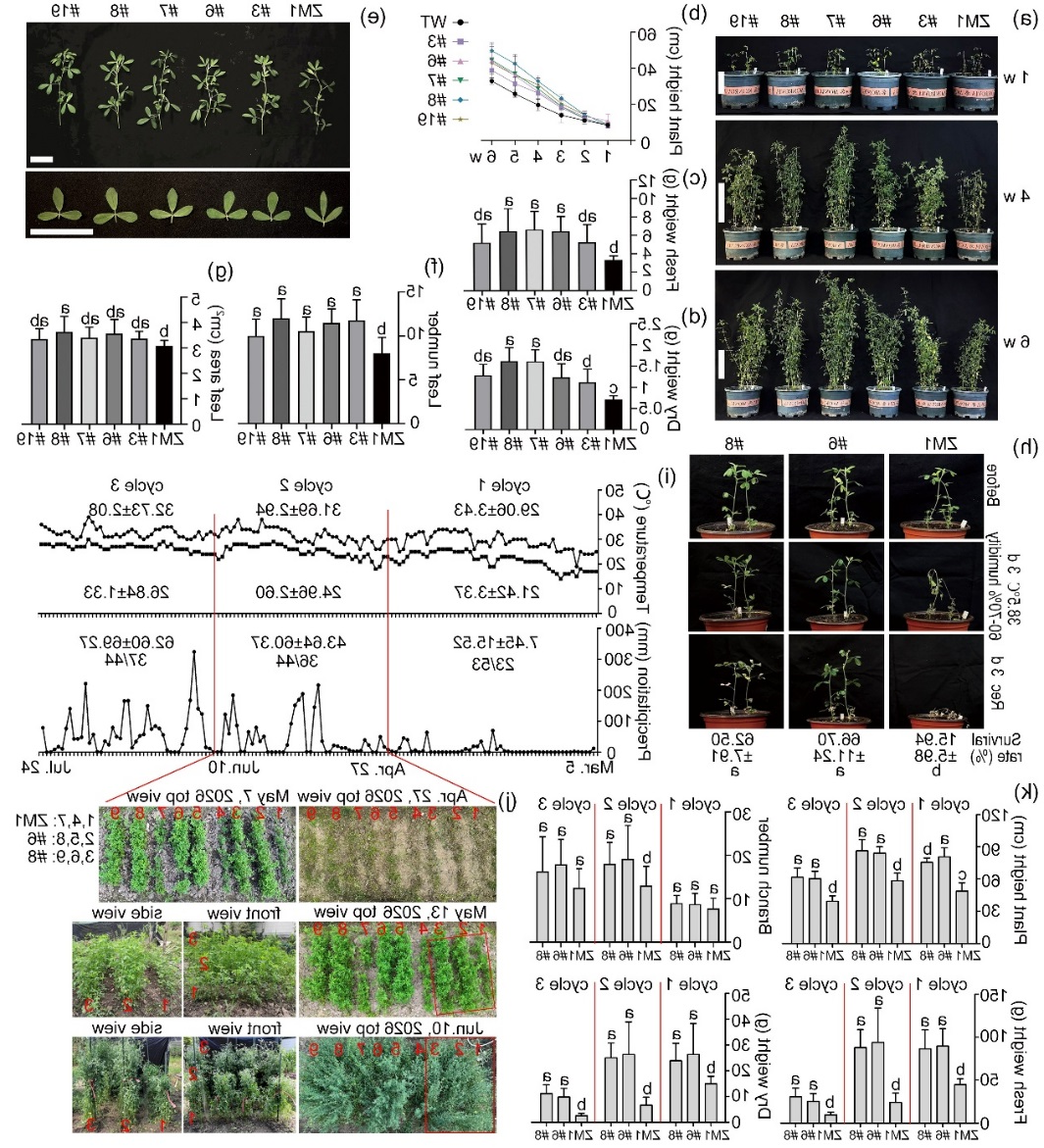
Figure. Overexpression of AtFLZ13 improves biomass yield and heat–humidity tolerance in alfalfa.(Image by YANG Chao)
File Download: