Systematically Reviews Functional Packaging Strategies: From Physiological Regulation to Intelligent Monitoring
Freshly harvested fruits remain as metabolically active living organisms with vigorous respiration and high ethylene sensitivity, and are therefore highly prone to softening, browning, water loss, and decay. At present, about 25% of the fruits are still lost in the post-harvest supply chain because of improper preservation, transport, or storage. Conventional petroleum-based plastic packaging serves only as a passive physical barrier and cannot adapt to the constantly changing physiological state of the fruit. Functional packaging, by contrast, regulates the in-package microenvironment and releases active substances to actively intervene in fruit respiration, ethylene signaling, oxidative stress, and microbial growth, and has become a frontier of postharvest preservation research. However, there is still a lack of systematic sorting out on how different materials and strategies act on fruit physiology and how they can move toward industrial applications.
To address the above questions, a comprehensive review by fruit and vegetable preservation team at South China Botanical Garden, CAS, has recently been published in Comprehensive Reviews in Food Science and Food Safety (IF5yr 19.4).
Taking “material structure-physicochemical property-fruit physiological response” as the main thread, the research team systematically reviews functional packaging strategies including moisture regulation, gas regulation, edible coatings, antioxidant and nutritional quality regulation, antimicrobial packaging, intelligent packaging, and shelf-life prediction. For example, a chitosan/nanocellulose coating limited weight loss in grapes to only 15.5% after 18 days of storage (40.4% in the control); a Pt/CeO2-P catalyst achieved an ethylene removal rate above 99.9% and maintained banana firmness for 14 days; and a machine-learning-assisted sensor array identified fruit ripeness with an accuracy of 99.09%. The review points out that moisture and gas regulation are governed by the same set of microstructural parameters, giving rise to both synergy and trade-offs, and that fruit type determines which functional layer should be prioritized, so no universally optimal solution exists. In terms of industrialization, stimulus-responsive metal-organic framework (MOF) carriers and AI-enabled intelligent packaging remain at the laboratory or early-prototype stage, and are still constrained by insufficient microstructural stability, lagging safety assessment, the difficulty of reconciling high cost and scalability with precise release (e.g., cellulose nanocrystals cost about 13 times as much as polypropylene), and differences in regulatory frameworks among China, the United States, the European Union, and other jurisdictions. In summary, the review proposes that future work should develop low-cost, “self-healing” bio-based materials and combine flexible sensors, radio-frequency identification (RFID), and machine learning to build closed-loop intelligent packaging based on “sensing-communication-prediction”, providing support for sustainable, high-performance postharvest preservation technologies.
This work is supported by the National Natural Science Foundation of China, the Guangdong Natural Science Foundation, the Guangdong Science and Technology Program, and the China Postdoctoral Science Foundation. The article link: https://doi.org/10.1111/1541-4337.70671
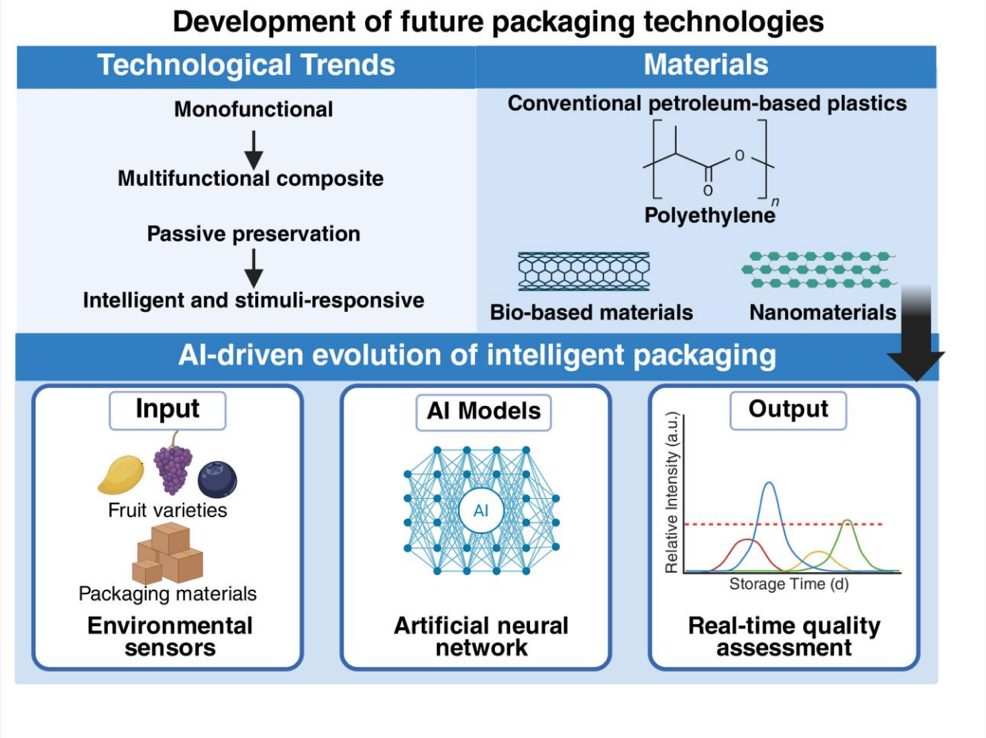
Figure. Future development directions of functional packaging technologies. In the future, intelligent packaging will no longer be confined to the physical or chemical improvement of materials themselves. Instead, it will deeply integrate materials science, sensor technology and physiological data of fruits by introducing AI models, thus achieving a leap from passive protection to predictive and real-time quality monitoring.(Image by ZHU Hong)
File Download: