Publication of A Checklist and Geographic Distribution of Vascular Plants in Xizang
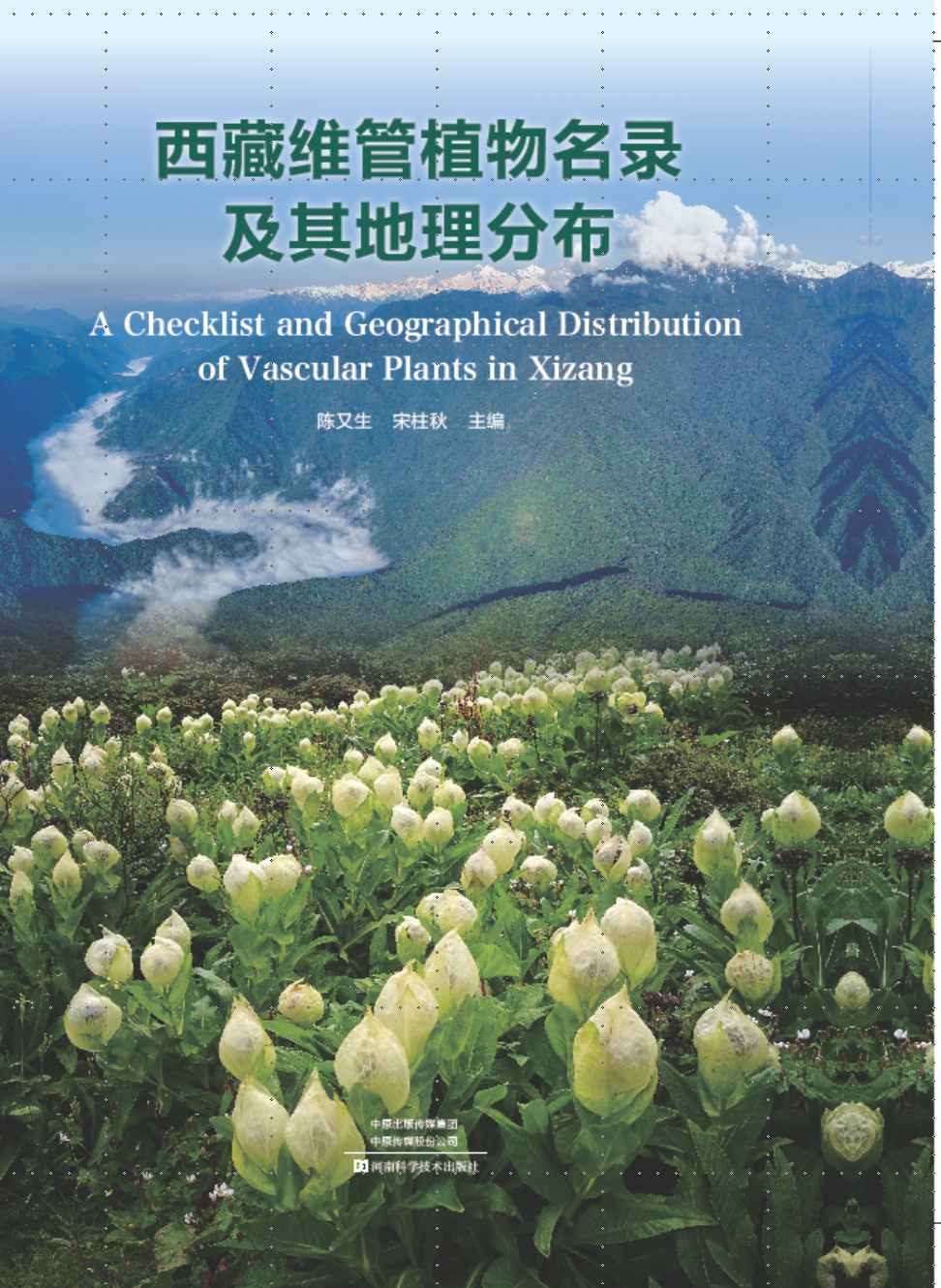
Recently, A Checklist and Geographic Distribution of Vascular Plants in Xizang, edited by Prof. CHEN Yousheng and Assistant Researcher SONG Zhuqiu of the South China Botanical Garden, Chinese Academy of Sciences, was published by Henan Science and Technology Press.
The book fills a long-standing gap in the vascular plant catalogue of southern Xizang. It represents the most comprehensive systematic compilation and update of Xizang’s vascular plant diversity since the Flora Xizangica (Vols. 1–5, 1983–1987), and stands as the most detailed foundational dataset on the region’s plant diversity to date.
The editorial board brings together more than 30 plant taxonomists from leading Chinese institutions, including the South China Botanical Garden, the Institute of Botany, the Kunming Institute of Botany, the Northwest Institute of Plateau Biology, the Guangxi Institute of Botany, and the Wuhan Botanical Garden. Distribution data are recorded for 74 county-level administrative units. Every record is supported by a rigorous voucher system and reviewed layer by layer by over 30 taxonomic specialists, providing an authoritative reference for plant diversity conservation, monitoring, and resource use.
Based on literature, herbarium data, images from National Specimen Information Infrastructure, Plant Photo Bank of China, and years of field surveys, the book documents 11,804 taxa (including infraspecific ranks) in 2,033 genera and 253 families of vascular plants in Xizang: 52 lycophytes, 703 ferns, 80 gymnosperms, and 10,969 angiosperms. Compared with the Flora Xizangica (208 families, 1,264 genera, 6,398 species), the total number of taxa increases by 5,406. After accounting for numerous previously recognized species that have been reduced to synonymy, the actual number of newly added species is about 6,037—631 more than a simple subtraction—a total increase of about 94%. In addition, 44 families and 734 genera are newly recorded (only genera with genuinely new species are counted; genera whose species were merely transferred are excluded). Many scientific names are also revised in this work. The ten most species-rich families are, in order: Asteraceae, Orchidaceae, Poaceae, Fabaceae, Rosaceae, Ericaceae, Ranunculaceae, Lamiaceae, Primulaceae, and Apiaceae.
The data are multisourced and fully traceable. They fall into four categories: (1) herbarium data—more than 36,100 distribution records, mainly from the National Specimen Platform (covering specimen information from major Chinese herbaria); (2) literature—over 27,300 records from the Flora of Xizang and other monographs as well as numerous new-species and new-record papers; (3) images from the National Specimen Information Infrastructure—about 11,600 distribution records; and (4) expert opinion. For every species in each county or city, a corresponding specimen number, literature citation, or image link is provided as voucher, allowing researchers to verify each record individually and ensuring the scientific rigor and reproducibility of the data.
The book specifically notes that many plant taxa of southern Xizang were previously under-recorded, while India has published at least 85 plant names based on this region under the pseudo-state name “Arunachal,” raising issues of national sovereignty. It emphasizes that Chinese researchers’ studies on plant diversity in disputed border areas are of great significance for safeguarding national sovereignty. The book also includes a list of doubtfully recorded or excluded vascular plants of Xizang, comprising 954 species in 477 genera and 124 families.
File Download: