Launches Genomic Database for China’s National Key Protected Wild Plants
Wild plants play a vital role in maintaining ecosystem stability and biodiversity, but human activities and climate change pose growing threats to rare and endangered species. Effective conservation requires not only protecting surviving individuals but also preserving the genetic diversity and adaptive potential of wild populations. Advances in genomics and population genetics have improved our understanding of species endangerment, genetic diversity, and conservation strategies. However, genomic data remain scattered across publications and public databases, with inconsistent curation and limited cross-referencing hindering their integration and reuse.
To address this challenge, a team led by Professor Ming Kang at the South China Botanical Garden, Chinese Academy of Sciences, developed the Genomic Database for National Key Protected Wild Plants (GDNPP), integrating genomic resources for China's nationally protected wild plants. Based on a systematic review of 381 publications, the database covers 291 species, including 626 reference genome assemblies from 234 species and 232 population genomic studies involving 147 species. The team curated genomic records, removed duplicates, assessed assembly quality, and standardized gene annotations. Reference genomes were further linked to population genomic studies, including their sampling information, analytical methods, and key findings, enabling integrated access to genomic resources at the species level.
To facilitate data access and analysis, GDNPP provides six modules: Home, Phylogeny, Species, Tools, Download, and General. The interactive phylogenetic tree covers all species listed in China’s List of National Key Protected Wild Plants and highlights differences in genomic data availability across taxonomic groups. The Species module allows users to filter species by taxonomy, protection status, and geographic distribution, with links to corresponding genome assemblies and population genomic studies. The Tools module offers genome browsing, sequence alignment, gene searches, and functional enrichment analysis. Together, these features facilitate the retrieval, analysis, and comparison of genomic resources across species.
The team’s analysis revealed uneven geographic and taxonomic coverage of genomic resources for China’s nationally protected wild plants. Nearly three-quarters of the species recorded in GDNPP occur in five provinces—Yunnan, Guangxi, Guizhou, Sichuan, and Guangdong—largely overlapping with China’s biodiversity hotspots. Genomic resources are also unevenly distributed across taxonomic groups, with sequenced species concentrated in a few orders, such as Asparagales and Rosales, while some orders remain unrepresented. Moreover, over 20 sequenced species still lack chromosome-level genome assemblies. These findings highlight gaps in genomic coverage and provide guidance for prioritizing future sequencing and genome assembly improvements.
GDNPP places particular emphasis on maximizing the conservation value of existing population genomic data. The team identified more than 30 nationally protected plant species, including Ormosia henryi and Coptis chinensis, whose previous population studies relied on reference-free approaches, closely related species’ genomes, or fragmented conspecific assemblies. With high-quality conspecific reference genomes now available, reanalyzing these datasets could improve assessments of genetic diversity, deleterious variant accumulation, and population history.
GDNPP also provides a foundation for long-term genetic monitoring of rare and threatened plants. By documenting sampling dates from existing population genomic studies, the team proposes using historical datasets as baselines for repeated sampling of the same populations. Such comparisons could track changes in genetic diversity, inbreeding, and deleterious variant accumulation over time, helping researchers identify priority populations, evaluate conservation effectiveness, and develop long-term conservation strategies.
GDNPP facilitates the sharing and reuse of genomic resources for China’s nationally protected wild plants and promotes their application in conservation. These efforts contribute to the goals of the Kunming–Montreal Global Biodiversity Framework, particularly the conservation of genetic diversity.
The study, “GDNPP: An integrated genomic database for national key protected wild plants in China,” was recently published online in Plant Diversity, a leading journal in biodiversity research. Kunyue Ouyang, a doctoral student at the South China Botanical Garden, is the first author. Professor KANG Ming and Associate Professor FENG Chao are the corresponding authors, and Associate Professor TANG Jianmin of the Guangxi Institute of Botany is a co-author. The work was supported by the Guangdong S&T Program, the National Key R&D Program of China, and the Guangdong Special Support Program, along with contributions from collaborating institutions and colleagues. Article link: https://doi.org/10.1016/j.pld.2026.11.002
Database website: https://www.gdnpp.com/
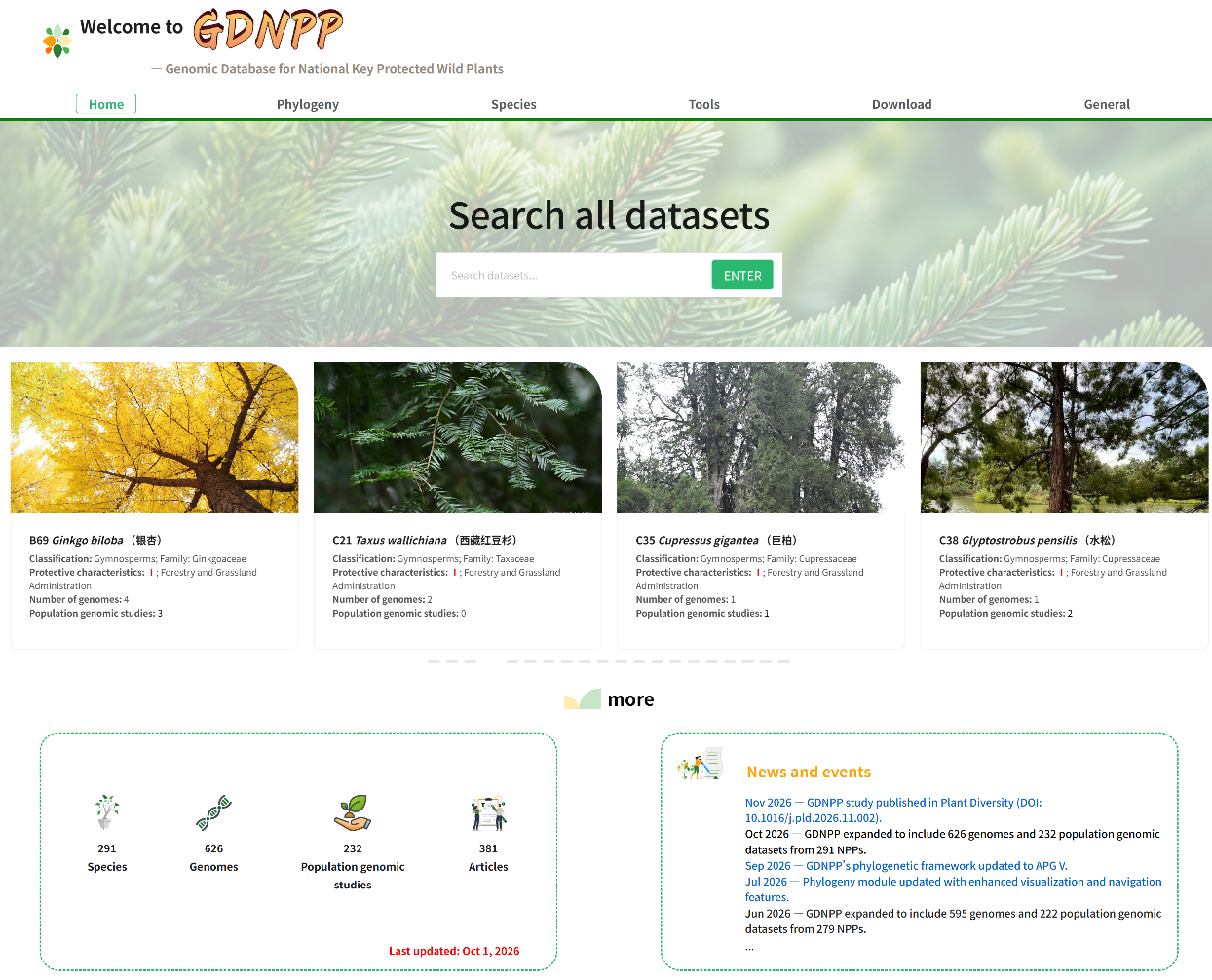
Figure. Overview of GDNPP.(Image by FENG Chao)
File Download: